On this page
If a softener on well water gets a little worse every month, even with normal salt use and regular cycles, the resin is probably coated with iron. A resin cleaner poured into the brine well before a regeneration usually brings it back. Check first that iron is the problem, then dose the cleaner to your resin volume.
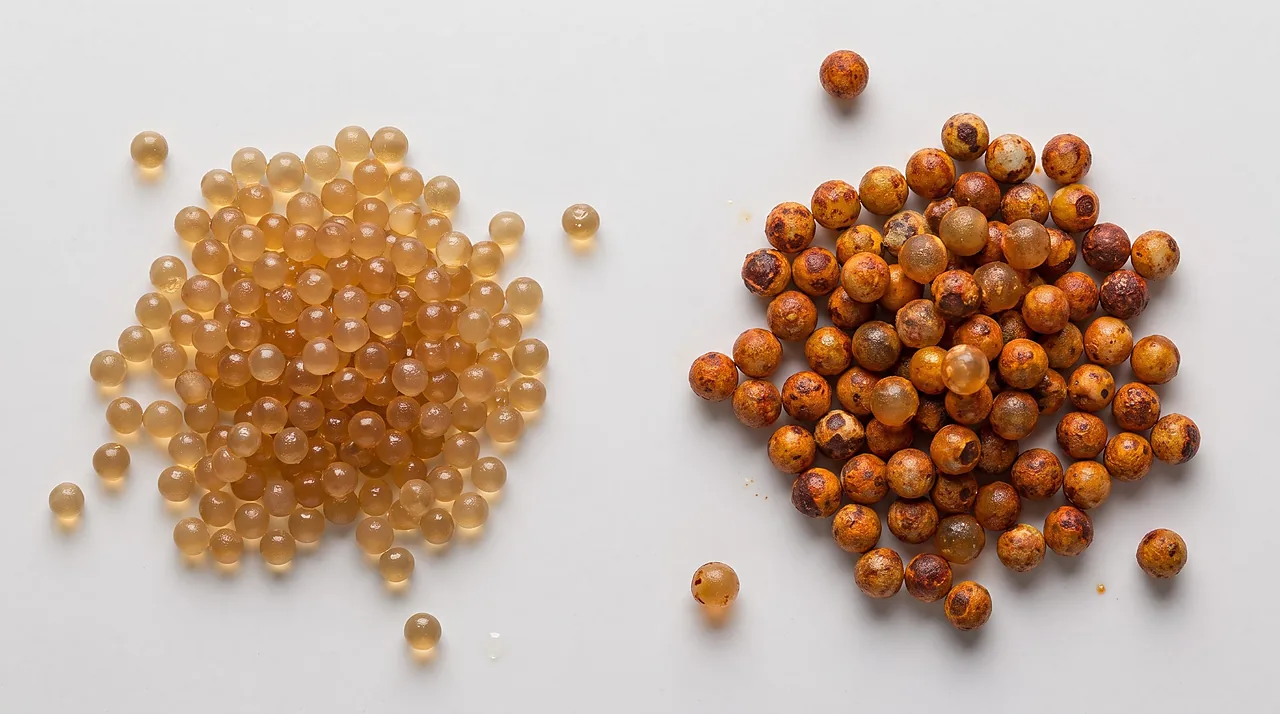
Resin is the bed of small plastic beads inside the tall resin tank that does the softening. Regeneration, the softener's cleaning cycle, washes hardness off those beads with brine from the salt tank. The brine is drawn up through the brine well, an upright tube in the salt tank that holds the float. Iron is the main mineral that brine can't wash off properly, which is why the cleaner exists.
Signs the resin needs cleaning, not a different fix

Iron fouling creeps up slowly. The water feels fine right after a regeneration, but you start noticing spots on the glasses a day or two before the next one. Then faint orange rings show up in the toilet bowl, while salt use looks normal the whole time.
Two other problems look similar, and cleaner won't touch either of them:
- The salt isn't reaching the resin. If the salt level hasn't dropped in a couple of weeks, or water stands high over the salt, the softener isn't drawing brine. Look for a salt bridge (a hard crust that keeps the salt from dissolving) or a clogged injector, the small nozzle that pulls brine in. The injector cleaning guide and the maintenance schedule cover both.
- The iron is already rust when it arrives. Fill a glass from a cold tap that skips the softener, such as an outdoor spigot, and let it stand. The Minnesota Department of Health describes the difference: clear-water iron comes out clear and turns red or brown after standing, while red-water iron is red or yellow straight from the faucet.
With regular cleaning, a softener can handle clear-water iron up to about 1 to 3 ppm, depending on the unit. On a well-water test, ppm and mg/L mean the same thing. Penn State Extension warns that iron already oxidized to rust clogs the resin. Cleaner can clear that for a while, but the rust keeps coming. Above about 3 ppm, or with red-water iron, the water needs an iron filter ahead of the softener, covered in softeners for well water.
Why salt alone can't clear iron
Resin cleaners do work. Purolite, a resin maker, explains that softener resin bonds to iron so strongly that brine can't reliably pull it back off. The iron builds up slowly and takes the place that calcium and magnesium should use, so each cycle softens fewer gallons. A cleaner dissolves that coating, and the next regeneration rinses it to the drain.
Purolite adds a second reason to act. Iron trapped on the beads speeds up the chemical damage that wears resin out, so a fouled bed softens less and also wears out sooner.
How much cleaner to use for your softener
Labels dose by cubic feet of resin. If your manual or tank label lists the cubic feet, use that number. If not, take the grain rating, the capacity in grains on the label. Most ratings assume about 32,000 grains per cubic foot of resin, so divide the rating by 32,000. A 32,000-grain unit holds about 1 cubic foot, a 48,000-grain unit about 1.5, and a 64,000-grain unit about 2.
Then multiply by the label dose. Pro Products Res Care, a common liquid cleaner, gives two:
- Maintenance dose
- 1/2 ounce (1 tablespoon) per cubic foot, added to the brine well before each regeneration. A 48,000-grain unit gets 3/4 ounce, about 1 1/2 tablespoons.
- Heavy-fouling dose
- 4 ounces (1/2 cup) per cubic foot, poured into the brine well, followed by a manual regeneration and repeated if needed. A 48,000-grain unit gets 6 ounces, or 3/4 cup.
Other brands use different strengths, so always use the numbers on your own bottle. The cubic-foot math stays the same.
How often to use resin cleaner
The interval depends on the product. Res Care's maintenance dose is small and goes in before every regeneration, either by hand or through an automatic feeder. Other cleaners use a bigger dose a few times a year instead, so follow the interval on your bottle. Both approaches get cleaner to the beads.
Your water decides how much it matters:
- Iron-free city water. Cleaner is optional. An occasional dose as the label describes is plenty.
- Well water with clear-water iron up to about 1 to 3 ppm. Treat the label schedule as part of owning the softener, because iron builds up whether you notice it or not. The Minnesota Department of Health calls iron above about 0.3 mg/L objectionable, so most iron wells are in this group. Run a heavy-fouling dose whenever hardness starts slipping before regeneration day.
- More iron than that, or red-water iron. Fit an iron filter first. Cleaner alone can't keep up.
One setting matters as much as the cleaner. Iron uses up softening capacity too. Add about 3 to 5 grains per gallon to the hardness setting for each 1 ppm of clear-water iron. Without that, the resin runs out before each regeneration and fouls faster.
Running a treatment, step by step

- Work out your dose from the resin volume and the label. Wear gloves, and never let the cleaner touch chlorine bleach; acid and iron-removing cleaners can release dangerous fumes with it.
- Pour it into the brine well. Lift its cap and pour straight into the water at the bottom, so the next cycle draws it in. If your unit has no brine well, follow the label's directions for that case.
- Start a manual regeneration right away, using the regenerate button or menu on your control head, the valve assembly on top of the resin tank. The cycle typically takes about 85 to 110 minutes and sends the loosened iron down the drain.
- Watch the drain water if you can. Rusty water during the rinse means iron is coming off. If it runs very dark on a heavy-fouling dose, repeat the treatment, as the label allows.
- Test the softened water once the cycle has finished, using a hardness strip or drop kit. It should read under 1 grain per gallon (gpg).
Which cleaner: liquid resin cleaner, Iron Out or homemade
For most homes, a liquid resin cleaner made for softeners is the best pick. An Iron Out style powder is the stronger option for heavy iron.
- Liquid resin cleaners are the simplest choice. They come with a dose per cubic foot, rinse out during regeneration, and many labels say they also remove manganese and silt.
- Iron Out style powders use sodium hydrosulfite, which turns rust back into a form that rinses away. They work, but they smell of sulfur, need a good rinse, and must never meet bleach.
- Homemade options such as citric acid or vinegar get suggested online. None of the sources here publish a dose for them, and vinegar is a weak acid. A labeled product is the safer bet for something that goes straight into your resin.
When resin cleaner stops helping

Cleaner strips coatings off healthy beads. It can't repair beads that chlorine or iron have already broken down. Resin typically lasts about 10 to 15 years on chlorinated city water, longer on clean well water, and iron fouling shortens both.
The cutoff is easy to see. Run a heavy-fouling dose and repeat it once. If soft water doesn't come back right after the cycle, the resin is worn out. The same is true if, even after that treatment, the water still turns hard long before the next scheduled regeneration. More bottles won't change that.
If the control head still runs its cycles normally, the tanks can usually be kept. Replacing the resin restores full capacity without buying a whole new softener.
Questions people ask
Can I pour resin cleaner on top of the salt?
Some labels allow it, especially for units without a brine well, but the brine well is better. Cleaner on top of the salt has to work its way down before the softener can draw it in, and some may wait there until a later cycle.
Does the cleaner get into my tap water?
It's meant to rinse down the drain during the regeneration it goes in with. Wait until that cycle has finished before you use water, and follow any extra rinse the label asks for.
Will resin cleaner remove the rust stains already in my toilets and shower?
No. The cleaner stays inside the softener and goes down the drain during regeneration. It stops new iron from getting through, but existing stains on fixtures need scrubbing separately.
Does resin cleaner fix chlorine damage?
No. Chlorine breaks down the beads themselves, and cleaner only removes coatings from them. Swollen, mushy resin that has lost capacity has to be replaced.
Is resin cleaner the same as cleaning the brine tank?
No, they're separate jobs. Resin cleaner works on the beads inside the resin tank. The brine tank gets emptied and scrubbed every two to three years with dish soap and water.
Read next


Sources
- Purolite, "Factors That Effect Softening Resin Performance and Life"
- Penn State Extension, "Water Softening"
- Minnesota Department of Health, "Iron in Well Water"
- Pro Products, Res Care resin cleaner product instructions