8 guides
Troubleshooting
Start from what you see, find the part that failed, and decide whether it's a cheap fix or the end of the unit.

Four checks that settle most calls.
Do them in this order before you buy a part or book a visit. Each takes a couple of minutes.
- 1
Power and clock
Display on, time right. After a power cut the clock resets and the softener regenerates at the wrong hour, or not at all.
- 2
Bypass in Service
Handles turned to Bypass send hard water straight to the house. Check it first, especially after any plumbing work.
Read the bypass positions - 3
Salt above the water
Loose salt should sit above the water line. Press a broom handle in: a hard crust on top is a salt bridge, and no brine gets made.
Break a salt bridge - 4
Force a regeneration
Start a manual cycle and watch it. If it never draws brine or never finishes, the problem is in the valve, not the salt.
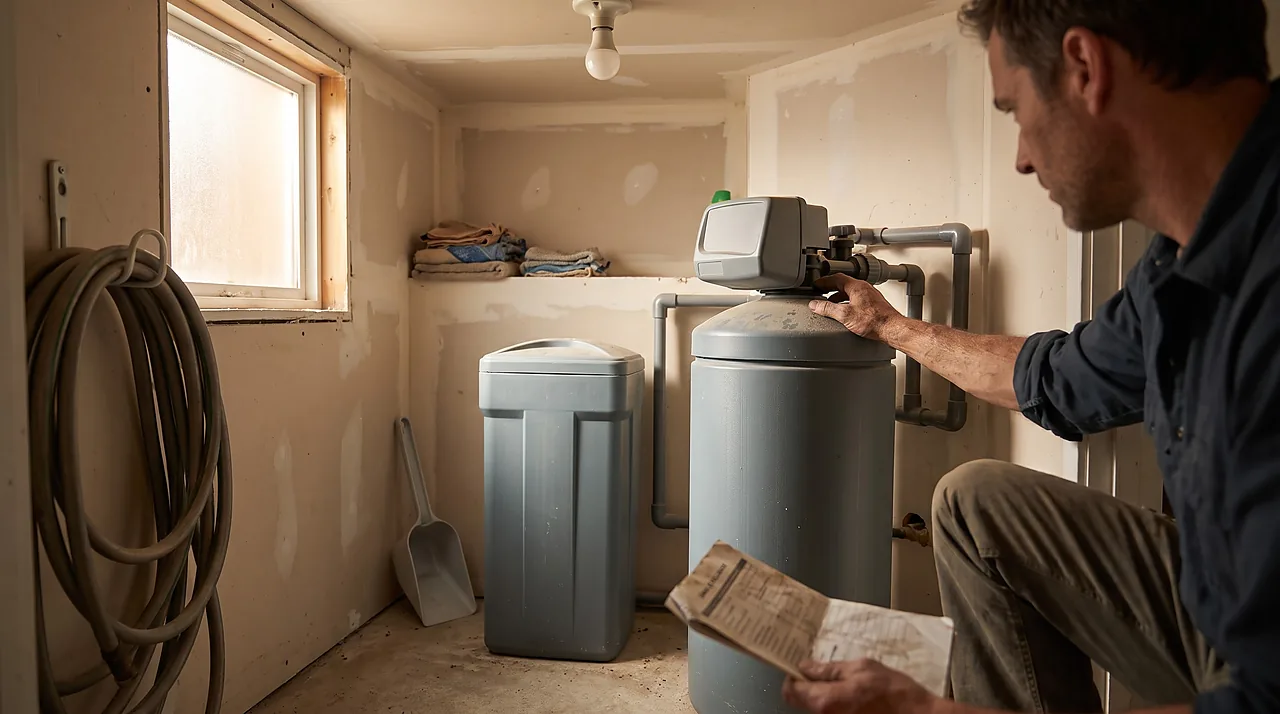
Find your problem fast.
Pick what you see. You get the first thing to check, then the guide with the full fix.
Every guide, by what's happening.
Hard water again
The softener runs, but spots and scale are back. Prove it first, then find where hard water slips through.

Salt and the brine tank
Salt that never goes down, water standing in the tank, or salt you can taste.


Leaks, noises and pressure
Water on the floor, a new sound at night, weak showers, or amber beads in the toilet.


Stuck cycles, blank displays and error codes
A valve that won't finish a cycle, a dead or flashing screen, and what each brand's codes mean.


Fix it or replace it
When the parts add up: a valve rebuild, the weak points of cabinet units, and where repair stops making sense.
Two-piece softeners on standard control valves often run 15 to 20+ years with seal and resin service; one-piece cabinet units more like 6 to 10. On a unit past 10 years, a single repair over about $400 to $500 usually loses to a replacement, which averages about $1,063 to $1,387 installed (Homewyse, 2026).
