On this page
Let the salt run low, then put the softener in bypass and unplug it. Empty the brine tank, scrub it with dish soap, sanitize it with a little bleach, rinse it well and refill it. It's an hour or two of work, and with clean salt you won't need to repeat it for two to three years.
The brine tank is the open salt tank, or the salt side of a one-piece cabinet unit. The tall resin tank next to it, which holds the beads that do the softening, is never opened and scrubbed by hand. Brown sludge in the bottom of the brine tank looks alarming, but it usually means dirt has built up, and the softener itself is fine.
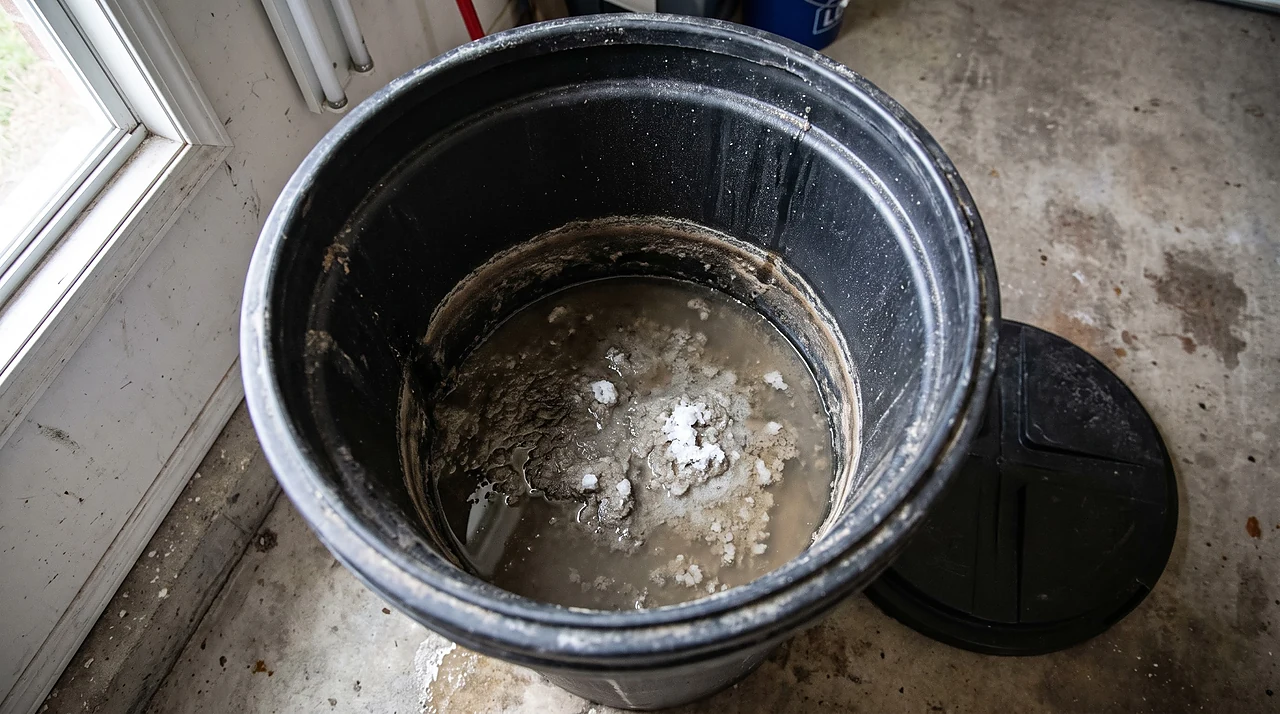
Brown sludge, slime or crust: what you're looking at
You lift the lid for the first time in years and the bottom looks like a pond. Before you clean, take a flashlight and work out what's down there, because each kind of mess points to a different cause.
- Brown or gray mud under the salt
- Dirt that came in with the salt and never dissolved. Pentair's Fleck SXT manual warns that rock salt and snow-melt salt may contain dirt. Rock salt leaves far more of this mud than pellets, so clean the tank and switch to salt made for softeners.
- Orange or rust-colored sediment
- Iron, common on well water. Clean the tank, then check the resin too, because the same iron coats the beads.
- Brown slime, bubbles, or a musty or rotten smell
- Bacteria growing in water left sitting with too little salt, often in a warm garage or a tank nobody has opened in years. Clean and sanitize the tank, and if the tap water smells too, see why a softener smells.
- A white paste at the bottom
- Salt mush, dissolved salt that has set again into sludge. It blocks brine from reaching the bottom of the brine well, where the softener draws it in.
- A hard crust partway up, with water or air under it
- A salt bridge. Break it with a broom handle first; the tank may not need a full clean at all.
Act once mud or slime reaches the bottom of the brine well, the upright tube that holds the float and the brine pickup. Past that point, grit gets pulled up the brine line, the thin tube between the tanks. From there it can clog the injector, the small nozzle that sucks brine out. It sits in the control head, the valve assembly on top of the resin tank.
What you need before you start
Start when the salt has burned down to the last few inches. The softener will use it up on its own over a few weeks, which saves you scooping out a hundred pounds of wet salt.
- A wet/dry shop vacuum, or a plastic scoop and a bucket, to empty the brine and sludge.
- A long-handled nylon brush and ordinary liquid dish soap.
- Plain, unscented household bleach. Skip scented and splashless types, which add perfume and thickeners, and color-safe bleach, which isn't chlorine bleach at all.
- Rubber gloves and safety glasses for the bleach step.
- A garden hose, or buckets of clean water, plus old towels.
- One or two 40-pound bags of fresh softener salt, pellets or clean crystals, for the refill.
Cleaning the brine tank, step by step

- Put the softener in bypass and unplug it. Turn the bypass valve to Bypass so the house keeps running water, then pull the plug. Unplugging keeps the valve from starting a cycle while the brine line is off, in case the bypass valve doesn't seal fully.
- Empty the tank. Set clean, dry salt from the top aside in a bucket if you want to reuse it. Throw out discolored or mushy salt, then vacuum or scoop out the brine and sludge. Pour it down a floor drain or utility sink, never on the lawn or garden, because salt builds up in soil.
- Disconnect the brine line and lift out the parts. Undo the fitting where the brine line joins the brine well, either a small nut or a push-fit collar. Pull off the overflow hose too, if there is one. Lift out the brine well with its float, then the salt grid (the perforated plastic shelf some tanks have at the bottom). A freestanding tank can now go outside or to a floor drain.
- Scrub with soapy water. Mix a few tablespoons of dish soap into a couple of gallons of warm water. Scrub the walls, the bottom corners, the salt grid and the outside of the brine well. Rinse the small screen at the foot of the brine pickup too, where grit tends to lodge, then rinse out the suds.
- Sanitize. Softener makers' and dealers' cleaning guides commonly suggest about a quarter cup of plain bleach in a couple of gallons of water. Swirl it over the walls, the grid and the float, and leave it for about 15 minutes. Never mix bleach with vinegar or ammonia cleaners, which releases harmful fumes.
- Rinse until the bleach smell is gone. Two or three rinses with clean water usually does it. Whatever stays in the tank gets drawn into the resin tank at the next regeneration, the softener's cleaning cycle.
- Put it back together. Lay the salt grid flat, stand the brine well in place and reconnect the brine line snugly, so it can't suck air. Check that the float moves freely up and down. A stuck float can't stop the refill, and that's how a clean tank ends up overflowing onto the floor.
- Refill and return to service. Add water if your manual calls for it; many tanks get a few gallons, enough to cover the grid. Then add salt until the tank is a quarter to half full, with the salt above the water line. Plug the softener in and turn the bypass valve back to Service.
Give the new salt a few hours to dissolve into brine, then run a manual regeneration. The last few cycles before the clean ran on weak brine, so the resin is probably partly spent. The cycle takes roughly an hour and a half. Watch the refill near the end: the water should stop well below the top of the tank. If it keeps climbing, go back to the float.
How often to clean the brine tank

Pentair's Fleck SXT manual says to empty and clean the brine tank every three years. That fits a home on clean salt with little iron, where every two to three years is plenty.
Rock salt and iron-rich well water both shorten the clock. If you see mud building up each time the salt runs low, clean the tank every year. The same goes for the injector: a Clack WS1 start-up guide suggests servicing it once a year, or up to three times a year above 5 ppm of iron. Iron that high usually calls for a separate iron filter ahead of the softener as well.
The simplest rule is to look. Every time the salt runs down, shine a light into the bottom. Clear water over a clean tank bottom means it can wait another year, whatever the calendar says. Pellets or clean crystals keep the tank cleaner for longer; how softener salt types compare explains the difference.
What a clean brine tank won't fix

A clean brine tank protects the injector and the brine line from grit. It does nothing for iron or dirt that has already coated the resin beads inside the resin tank.
Never unscrew the control head to scrub the resin tank. Resin is cleaned chemically, in place. On iron-rich well water, hard water or rust stains can outlast a clean tank and a regeneration. If they do, pour a resin cleaner into the brine well. The next cycle carries it through the beads. To see where this job fits next to the monthly salt check and the yearly injector cleaning, use the maintenance schedule.
Questions people ask
Can a dirty brine tank affect the water from my taps?
Indirectly. Brine passes through the resin tank and is rinsed down the drain before the softener returns to service, so the tank isn't a straight path to your taps. But grit can clog the injector, and slime drawn into the resin tank is a common source of softener smells.
Can I pour bleach into the brine well and regenerate?
Some softener manuals describe a small sanitizing dose poured into the brine well before a regeneration. Use the dose your manual gives and keep it occasional, because strong chlorine wears out resin and o-rings over time. A full sanitizing routine is a separate job from cleaning the tank.
Can I use vinegar instead of bleach?
For scrubbing, yes. Vinegar loosens scale rings on the tank wall, but it isn't a disinfectant like bleach, so use bleach if the tank was slimy or smelled. Rinse the vinegar out completely first, because the two must never mix.
Do I have to take the brine tank outside to clean it?
No. You can clean it in place with a shop vacuum, a brush and buckets of rinse water. Moving it outside just makes rinsing easier.
How do I clean a cabinet softener where the resin tank sits inside the salt bin?
Put it in bypass, unplug it, scoop out the salt and vacuum the water and sludge from around the inner cylinder with a narrow nozzle. Wipe the walls with a soapy cloth, rinse with a wet sponge and vacuum again. Clean the removable brine well in a sink.
Will the resin dry out while the brine tank is empty?
No. The resin stays under water inside the sealed resin tank the whole time. Bypass just routes house water around the softener until you switch it back to Service.
Read next


Sources
- Pentair, Fleck SXT Controllers Owner's Manual
- Van Isle Water, WS1 Softener Installation & Start-Up Guide (Clack WS1 valve)
- Water Quality Association (WQA), Glossary of Terms
- U.S. Environmental Protection Agency (EPA), Emergency Disinfection of Drinking Water