On this page
A home water softener needs very little: a five-minute look at the salt each month and about an hour of checks each year. Every two to three years, add a brine tank clean. You can do all of it yourself with a broom handle, a hardness test kit, a bucket and a wooden toothpick.
What a softener can't take is years of nothing but fresh salt. That's how it ends up with a salt crust it can't draw from, a clogged injector, or resin (the beads that do the softening) coated in iron. The first sign is usually spots coming back on the glasses.
The whole schedule on one page
- Every month, 5 minutes
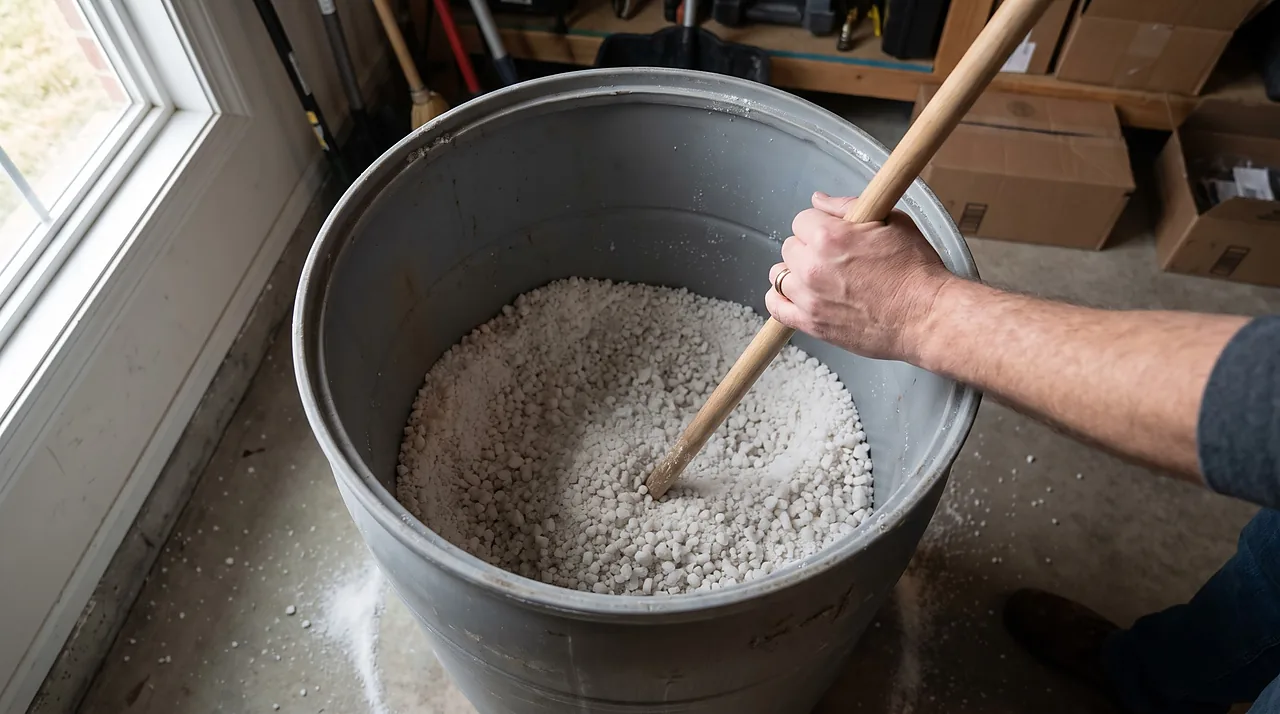
- Lift the lid of the brine tank (the salt tank). Check that dry salt sits above the water and the tank is a quarter to half full. Then push a broom handle down through the salt to feel for a hard crust.
- Every year, about an hour
- Test the softened water and feel for sludge at the bottom of the brine tank. Then clean the injector, the small nozzle that pulls brine out of the brine tank, and check the clock and hardness setting. Finally, turn the bypass valve (the valve on the pipes behind the softener that lets house water skip it) to Bypass and back.
- Every two to three years, an hour or two
- Let the salt run low, then empty and scrub the brine tank. Make it yearly if you use rock salt or keep finding sludge.
- Only if your water has iron
- Add a resin cleaner on the schedule its label gives, so rust doesn't build up on the resin.
- From about year 10
- Watch for signs the resin is wearing out. It typically lasts about 10 to 15 years on chlorinated city water, longer on clean well water.
If a service plan promises more than this, ask what each extra visit actually does.
Monthly: the five-minute salt check

Lift the brine tank lid once a month. Pentair's Fleck SXT manual states one rule plainly: the salt level should always be higher than the water level in the tank. Keep the tank a quarter to half full, and use only salt made for water softeners.
There's no prize for filling it to the brim. A packed tank only makes the check harder, because you can't see the water line or reach the bottom. Most households go through 40 to 80 pounds a month, which is one or two 40-pound bags. If yours suddenly jumps or stops moving, the salt use guide helps you work out why.
While the lid is off, push a broom handle straight down through the salt. If it slides to the bottom, you're done. If it stops on a hard shelf partway down, you've found a salt bridge, a crust with a hollow space under it.
A bridge is sneaky. The tank looks full every time you lift the lid, yet the shower has stopped feeling slippery and the kettle is scaling up again. The water underneath never touches the salt, so the softener cleans itself with weak brine.
Yearly: the one-hour walk-through

EPA's WaterSense home maintenance checklist puts the softener on its once-a-year list: have a professional service it, or do the basic care yourself. These six steps cover the usual service points, in an order that avoids doing anything twice.
- Test the softened water first. Run a cold tap that gets softened water for 30 seconds and test it with a hardness strip or drop kit. Some kitchen taps are left hard on purpose, so pick one you know is softened. A healthy softener reads under 1 grain per gallon (gpg), the Water Quality Association's line for soft water. Test an outdoor spigot too, since those usually skip the softener and show your untreated hardness. A softened reading creeping toward that number means the salt isn't reaching the resin, or the resin is losing capacity.
- Feel for salt mush. Push the broom handle to the bottom of the brine tank. A soft, pasty layer is salt mush, dissolved salt that has set again into sludge. It can block the brine well, the tube the softener draws brine through, so scoop it out or move the deep clean up.
- Check the settings. A power outage resets the clock on many control heads, which can move the 2 a.m. regeneration into your morning shower. Also make sure the hardness setting matches the untreated number you just tested. The hardness setting guide explains what to enter and why a city average is a poor guess.
- Release the pressure. Turn the bypass valve to Bypass, and look at its o-rings for cracks or dryness as you move it. On many valves you then start a manual regeneration (the softener's cleaning cycle) and let it run for a minute. Trapped water bleeds out the drain hose. Unplug the softener before you open anything. The yearly turn also keeps the bypass valve from seizing, which happens to valves left untouched for years.
- Clean the injector. It sits in the control head, the valve assembly on top of the tall resin tank, and grit or iron can block its pinhole. Unscrew the injector cap (your manual shows where it sits), rinse the screen, and clear the hole with warm water and a wooden toothpick. A metal pin can scratch the hole and weaken the suction.
- Put it back in service. If a bypass o-ring looked dry, wipe on a little food-grade silicone grease; skip petroleum jelly, which can make rubber seals swell. Plug the softener in and turn the bypass valve back to Service slowly, so trapped air pushes out gently. Many valves resume the cycle you started, so let it finish, or start a manual regeneration if yours doesn't. Watch the injector cap and the drain hose connection for drips.
Iron changes the routine. Penn State Extension notes that iron already oxidized to red rust clogs resin, so red-water iron needs its own iron filter ahead of the softener. Clear-water iron, the kind that comes out clear and turns rusty in the glass, is different: a softener copes with it up to about 1 to 3 ppm, depending on the unit. It still coats the beads gradually, which is what a resin cleaner is for. On iron-heavy or gritty well water, check the injector screen more than once a year. A sediment prefilter ahead of the softener helps keep it clear.
Every two to three years: the deep clean

Two good sources disagree on this one. EPA's checklist puts brine tank cleaning on the yearly list, while Pentair's Fleck SXT manual says to empty and clean the tank every three years.
A practical way to settle it is the salt you buy. With clean pellets or crystals, every two to three years is enough. With rock salt, which carries more dirt, or whenever you find sludge or a gray film at the water line, clean it every year.
Plan ahead so you don't throw away good salt. Stop topping up a couple of weeks before, so the pile runs low. Then scoop out what's left, bail or vacuum out the brine, and scrub the walls and bottom with dish soap and water. Rinse well before you add fresh salt. The full steps, including how much water to add back, are in how to clean a brine tank.
Once the softener passes year 10, keep an eye on the resin. Chlorine and iron are what wear it down, so clean well water gives it the longest life. The usual first sign is hard water that returns even with good salt and a clean injector. Worn beads can also turn soft and pack down, which cuts your water pressure. On chlorinated water, the 8% vs 10% crosslink guide explains why some owners choose tougher resin when it's time to replace it.
Haven't touched it in years? Start here
Plenty of softeners get nothing but salt for five years and keep working, until they don't. The broom handle hits a crust you can't break, or the bottom of the tank looks like wet cement. Work in this order, because each step clears the way for the next one:
- Test the softened water so you know where you stand before you touch anything.
- Break any salt bridge with the broom handle, then stop adding salt.
- Clean the brine tank once the pile is low, so you start over with clean salt and a clear brine well.
- Clean the injector, releasing the pressure first the same way as in the yearly steps.
- Run a manual regeneration with fresh salt in the tank, and test again the next day. If the water is still hard, the problem is beyond maintenance: start with softener not softening.
Doing it yourself or paying for service
Everything on this schedule is a homeowner job. None of it needs special tools, and the only parts involved, o-rings and silicone grease, are cheap. Service companies charge for the visit plus parts, and prices vary a lot by region. Ask for a written quote that lists what the visit includes, and compare it with the one on this page.
The steady cost of owning a softener is salt. At 40 to 80 pounds a month, that's 12 to 24 bags a year. At about $7 to $12 a bag, it comes to roughly $85 to $290. Check current prices at your local store.
A pro earns the fee when the job goes past the schedule. That means a leak you can't trace, a control head that won't finish its cycle, or a resin replacement on a tank you'd rather not open.
What is not routine maintenance
- Sanitizing. The Water Quality Association warns that strong chlorine can wear out o-rings and resin, so bleach isn't a yearly chore. Sanitize the softener after a flood, after repairs that opened the water lines, or after months sitting unused. If the water or the brine tank smells, find out why the softener smells first.
- Winterizing. A softener in a heated basement needs nothing. One in an unheated garage or cabin where it can freeze has to be drained; see how to winterize a softener.
- Repairs and upgrades. When an old unit has worn-out resin and a leaking valve at the same time, more maintenance won't save it. Weigh repair or replace, or see whether a new control valve on the old tanks makes sense.
Every guide in Maintenance
Questions people ask
Does a water softener need maintenance if it seems to work fine?
Yes, though not much. A salt bridge or a clogged injector builds up quietly while the water still feels soft. By the time spots return, the softener may have been regenerating on weak brine for weeks, and the monthly salt check would have caught it.
How long does a water softener last?
The resin is usually the first major part to wear out, typically after about 10 to 15 years on chlorinated city water and longer on clean well water. Resin can be replaced and a worn control valve rebuilt or swapped, so a softener with sound tanks can keep going after that. Seals, o-rings and the brine float wear out sooner, but they're cheap.
Why did my salt use suddenly change?
If the salt stops going down, check for a salt bridge first, then a clogged injector or a kinked brine line (the tube between the two tanks). If use suddenly doubles, look for a running toilet or a dripping faucet. On a softener with a water meter, that hidden flow counts toward the next regeneration and triggers extra cycles.
Does maintenance differ on well water?
Yes. On iron water, clean the injector screen more often and use a resin cleaner on a schedule. City water carries little grit, so there the main long-term wear is chlorine slowly breaking down the resin.
Is water softener cleaner the same as resin cleaner?
Usually, yes. Products sold as softener cleaner are poured into the brine well before a regeneration and clean the resin. For the brine tank itself, dish soap, water and a scrub brush do most of the work.
Read next


Sources
- EPA WaterSense, "Maintenance Checklist for a Water-Efficient Home"
- Pentair, Fleck SXT Owner's Manual
- Water Quality Association, "Guidance for Sanitizing Residential Drinking Water Treatment Systems"
- Penn State Extension, "Water Softening"