On this page
- Step one: test or look up your hardness
- Step two: add iron if you have any
- Step three: turn people and hardness into a weekly load
- Step four: match the weekly load to usable capacity
- Worked example: a family of four
- Quick size chart for 1 to 6 people
- Too big or too small: does the size really matter?
- Flow rate: the other number on the spec sheet
- Size it for your house
Multiply the number of people in your home by 75 gallons, then by your water hardness in grains per gallon (gpg), then by 7. The result is how many grains of hardness the softener has to remove in a week, and that weekly load decides the size.
For a family of four on 10 gpg water, that's 4 x 75 x 10 x 7 = 21,000 grains a week. A softener sold as "32,000-grain" is the usual fit, but not because of the box number. At a sensible salt setting it delivers about 20,000 usable grains, so it cleans itself about every six days.
Step one: test or look up your hardness

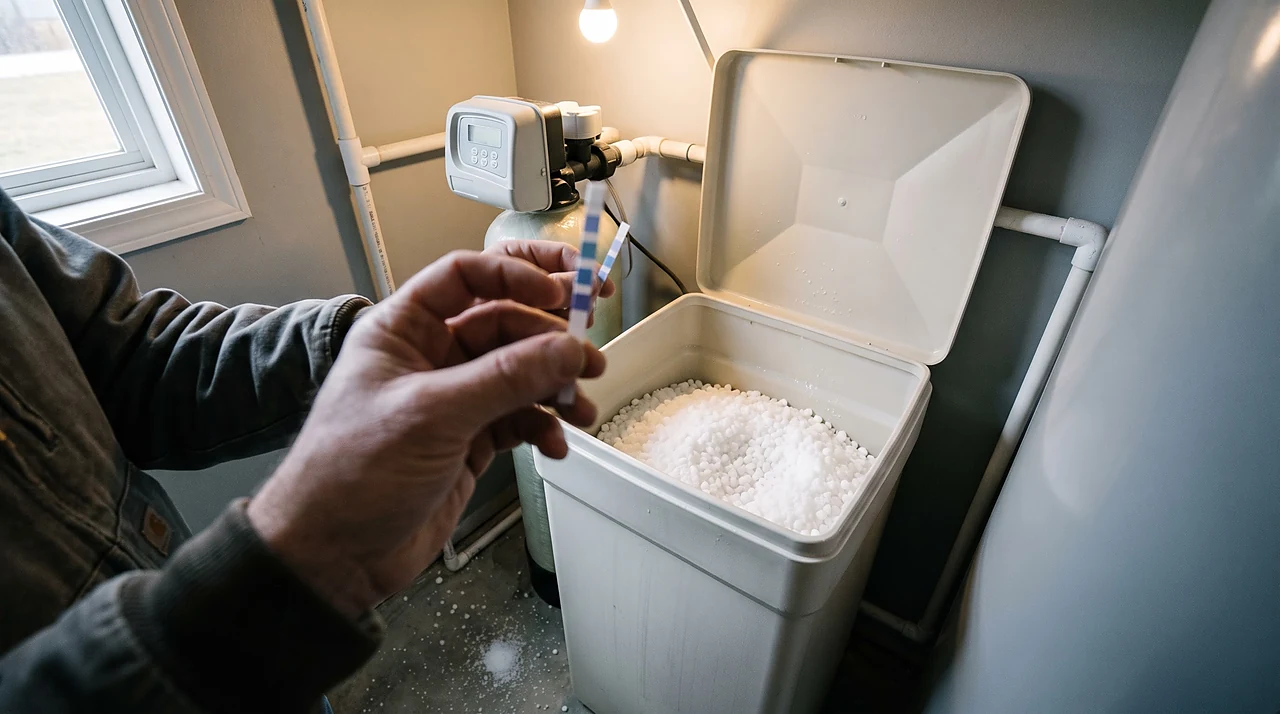
Every other figure in the math gets multiplied by this one, so a guess here ruins the result. On city water, look up hardness in your utility's annual water quality report. If it gives a range, use the high end, because the number can shift through the year. On a private well, test the water with a hardness test kit or send a sample to a lab.
Reports often list hardness in mg/L or ppm (parts per million) instead of gpg. Divide by 17.1 to convert, so 171 mg/L is 10 gpg; the ppm to gpg guide has the full conversion. For scale, the Water Quality Association calls 7 to 10.5 gpg hard and anything over 10.5 gpg very hard.
The number keeps mattering after installation. The softener works by trapping hardness in its resin, a bed of small plastic beads inside the tall tank. A metered control valve is the electronic head on top of that tank that decides when to clean the resin. It divides its capacity by the hardness you enter to work out how many gallons it can treat. Enter a figure that's too low and it waits too long, so hard water reaches your taps before the cycle starts.
Step two: add iron if you have any

Clear-water iron is the dissolved kind: the water comes out clear and only turns orange after it sits. The softener removes it the same way it removes hardness, and it uses up resin capacity just the same. So for every 1 ppm of clear-water iron, add 3 to 5 gpg to your hardness before you do the math.
Water at 10 gpg with 1 ppm of iron gets sized as 13 to 15 gpg. If you're unsure where you fall in that range, use the top.
A softener has limits with iron. It handles clear-water iron only up to about 1 to 3 ppm, depending on the unit. The Water Quality Association adds that rated efficiency holds only under 2 ppm.
Above that range, you need an iron filter ahead of the softener. The same goes for water that's rusty straight from the tap or leaves slimy orange film in the toilet tank. The well water guide covers that setup.
Step three: turn people and hardness into a weekly load
Now the arithmetic. Multiply the people in the house by 75 gallons a day, then by the hardness from steps one and two. That's the daily load in grains, and seven days of it is the weekly load.
Why 75 gallons each? The Water Quality Association starts from about 200 gallons a day for a family of four, which is 50 per person. Sizing charts commonly use 75, which leaves room for guests, laundry days and older fixtures. The extra margin costs little: a metered valve counts the gallons you actually use, so a generous estimate only nudges you toward a slightly bigger tank.
The softener regenerates, or runs its cleaning cycle, whenever the resin is nearly full. Each cycle usually starts around 2 a.m. and sends roughly 35 to 65 gallons down the drain. About once a week is the usual target: a smaller tank cycles more often and spends more water, while a much bigger one costs more for resin that mostly sits idle.
Step four: match the weekly load to usable capacity
This is where buyers often get the wrong size. The grain number on the box assumes the softener floods each cubic foot of resin with about 15 pounds of salt. Few homes should run it that way, because every extra pound of salt buys less softening than the last.
That amount is the salt setting: the pounds of salt the valve uses for each cubic foot of resin, every cycle. At each salt setting, one cubic foot of resin gives roughly:
- 12,000 grains at 3 lb of salt, about 4,000 grains per pound. This is the efficiency the Water Quality Association asks softeners to be set for.
- 20,000 grains at 6 lb, about 3,300 grains per pound. A common middle salt setting, and the one the rest of this page sizes for.
- 30,000 to 32,000 grains at about 15 lb, only about 2,000 grains per pound. This is where the box number comes from.
So divide your weekly load by 20,000 to get the cubic feet of resin you need at the 6-lb setting. For the leaner 3-lb setting, divide by 12,000 instead, which means about two-thirds more resin.
Labels count about 32,000 grains per cubic foot. That's why 1 cubic foot is sold as a 32,000-grain softener, 1.5 as 48,000 and 2 as 64,000. The grain capacity guide has the full table of salt settings for each tank size.
Worked example: a family of four
Take four people on city water that tests at 10 gpg, with no iron:
- Water use: 4 people x 75 gallons = 300 gallons a day.
- Daily load: 300 gallons x 10 gpg = 3,000 grains.
- Weekly load: 3,000 x 7 = 21,000 grains.
- Resin: 21,000 divided by 20,000 is about 1 cubic foot, sold as a 32,000-grain softener.
At the 6-lb setting that tank regenerates about every six days, close to the target. The label's 32,000 grains would suggest more than ten. That gap often explains why a new softener seems to regenerate too often.
One size up is worth pricing. A 1.5-cubic-foot tank, sold as 48,000-grain, can run the lean 3-lb setting: 18,000 grains per cycle from 4.5 lb of salt. The family's 21,000 grains a week then cost about 5 lb of salt instead of about 6. Over a year that's about 55 lb, a little over one 40-lb bag, or roughly $10 to $17 at current prices. It only pays if the bigger tank costs little more.
Move the same family to a well with 10 gpg hardness and 1 ppm of iron, and it sizes as 13 to 15 gpg. The weekly load becomes 27,300 to 31,500 grains, which points to 1.5 cubic feet at the 6-lb setting.
Quick size chart for 1 to 6 people

The four steps shrink to one shortcut at the 6-lb setting: people x hardness in gpg, divided by 40, gives the cubic feet of resin for a cycle about once a week. Four people on 10 gpg water need 4 x 10 / 40 = 1 cubic foot. The chart rounds up to sizes you can actually buy.
| People | At 10 gpg | At 20 gpg |
|---|---|---|
| 1 | 0.5 cu ft (16,000 label) or smaller | 0.5 cu ft (16,000 label) |
| 2 | 0.5 cu ft (16,000 label) | 1 cu ft (32,000 label) |
| 3 | 0.75 cu ft (24,000 label) | 1.5 cu ft (48,000 label) |
| 4 | 1 cu ft (32,000 label) | 2 cu ft (64,000 label) |
| 5 | 1.5 cu ft (48,000 label) | 2.5 cu ft (80,000 label) |
| 6 | 1.5 cu ft (48,000 label) | 3 cu ft (96,000 label) |
For one or two people in a rental, a portable softener may fit better than any tank on this list. At the other end, six people on very hard water need about 3 cubic feet. That's where a twin-tank softener, with two resin tanks taking turns, starts to make sense.
Past about 30 gpg, the Water Quality Association warns that some hardness may slip through. A result that high is worth a lab test and a professional opinion before you buy.
Too big or too small: does the size really matter?
It matters most when the tank is too small. Picture a 24,000-grain softener (0.75 cubic feet) serving a family of four on 20 gpg water. At the 6-lb setting it holds about 15,000 grains, and the family brings in 6,000 a day, so it regenerates every two to three days.
That's two or three cycles a week where one would do, each sending 35 to 65 gallons down the drain. And on the day you run four loads of laundry, the resin can run out hours before the 2 a.m. cycle. You notice it in the evening shower, when the shampoo suddenly won't lather.
Too big costs money in a quieter way. You pay more for the tank and the resin, and the Water Quality Association's own guidance calls oversizing wasteful. Many metered valves also have a calendar backup that forces a cycle after a set number of days. On an oversized tank, that cycle often comes before the extra resin is ever used.
One size up is reasonable if the household will grow or you want the lean 3-lb setting. Two sizes up mostly buys resin you'll never use.
On a well, a big tank has one more catch. A bigger tank is also wider, and a wider tank needs a stronger backwash flow, the upward rinse that loosens the resin at the start of each cycle. A weak well pump may not keep up, so compare the backwash rate on the spec sheet with what your pump delivers.
Flow rate: the other number on the spec sheet
Grain capacity sets how often the softener cleans itself. Service flow rate, in gallons per minute (gpm), sets whether the shower weakens when the washer and a second bathroom run too. To check it, add up the flow of everything that runs at once in your busiest five minutes, usually the morning rush. Showerheads and faucets often have their gpm stamped on them. Then compare the total with the rating on the spec sheet.
House size and bathroom count don't set the grain size at all. They only matter here, for flow.
Bigger resin tanks and larger valves generally carry more flow. A home with a tankless water heater should check this number closely, because the heater adds its own pressure drop.
With the size and flow settled, how to choose a water softener covers valve types and features. The Fleck 5600SXT programming walkthrough shows how to enter your hardness and salt setting, so the tank delivers the capacity you sized it for.
Size it for your house
Every guide in Choosing and sizing
Questions people ask
How long does a 40 lb bag of salt last in a water softener?
Work out the pounds you use in a week: salt setting x cubic feet of resin x cycles per week. The family of four in the worked example uses about 6 lb a week (6 lb x 1 cubic foot, a little more than once a week), so one bag lasts roughly six weeks. Typical households use 40 to 80 lb a month, so a bag every two to four weeks is common on harder water or bigger families.
Is a 48,000-grain softener right for a family of four?
A 48,000-grain unit holds about 1.5 cubic feet, and at the 6-lb setting it covers a week when people x hardness in gpg comes to about 60 or less. That's four people on water up to about 15 gpg, six people at 10 gpg or three at 20 gpg. On 10 gpg water a family of four is one size under it, which is fine if you want the lean 3-lb setting.
Can I size with 50 gallons per person if we have low-flow fixtures?
You can, and the Water Quality Association's own baseline of 200 gallons a day for four people supports it. Four people on 10 gpg water then come to 14,000 grains a week, about 0.75 cubic feet. Use it only if you know your use is low, ideally from a water bill, because an undersized tank is the more annoying mistake.
Should I count outdoor hose water in the sizing math?
No. Lawn and garden taps should be plumbed ahead of the softener, on untreated water, because sodium builds up in soil. A long sprinkler run through a softener can also use up days of grain capacity at once.
Can I use my water bill instead of 75 gallons per person?
Yes, and it's more accurate. Use a winter month's bill, when there's almost no outdoor watering, and divide the gallons by 30 for the daily figure. If the bill is in hundred cubic feet (CCF), multiply by 748 to get gallons first. Then multiply by your hardness and by 7, exactly as in the steps.
Read next


Sources
- U.S. Geological Survey, Water Science School
- Water Quality Association, "Getting Smart With Softeners"
- Pentair, Fleck 5600SXT Downflow Service Manual
- Purolite (Ecolab), C100E Product Data Sheet