On this page
A water softener takes calcium and magnesium out of your water. Those two minerals leave white crust on faucets and scale inside your water heater. A softener earns its place when a test shows about 7 grains per gallon or more. It won't fix a sulfur smell, bacteria, or chlorine taste.
Every home softener works on the same basic idea, so once you understand one, dealer quotes and store shelves get much easier to read. Already know what you need? Jump to the guide for your situation.
Which guide do you need?
Find your situation, then follow the links.
- You're not sure your water is hard
- Match what you see on glasses and fixtures to the signs of hard water, then get an exact number with a home hardness test. If a lab report lists ppm or mg/L instead of grains per gallon, the ppm to gpg guide converts it.
- You're choosing a softener
- Start with what size you need and why the grain number on the box overstates what you'll get. Then compare salt-based and salt-free systems and read how to choose by your numbers. On a private well, size it with iron in the mix.
- You're getting one installed
- Check a quote against the installation cost breakdown and choose a spot with the guide to where to install it. Then find out whether you need a plumber or a permit. Doing it yourself? Follow the DIY install checklist.
- It's new and you're setting it up
- Read the first 30 days, then what each setting means and which hardness number to enter. There are walkthroughs for the Fleck 5600SXT, the Clack WS1, and GE panels.
- You have a question about salt
- Choose between pellets, crystals, and blocks, learn how much salt to add, or weigh potassium chloride. If the salt level hasn't dropped in weeks, check for a salt bridge.
- It's time for upkeep
- The maintenance schedule lists every task by month and year, including cleaning the brine tank and replacing the resin. For an older unit, weigh repair or replace.
- Something has gone wrong
- Hard water again? Start with the not-softening triage or the three tests that show it's working. Separate guides cover leaks, a brine tank full of water, salty-tasting water, low pressure, smells, strange noises, regenerating too often, and hardness creeping back.
- You're living with soft water
- Get the facts on sodium, plants and pets, spots that won't go away, a septic system, and moving house.
What happens inside the tank

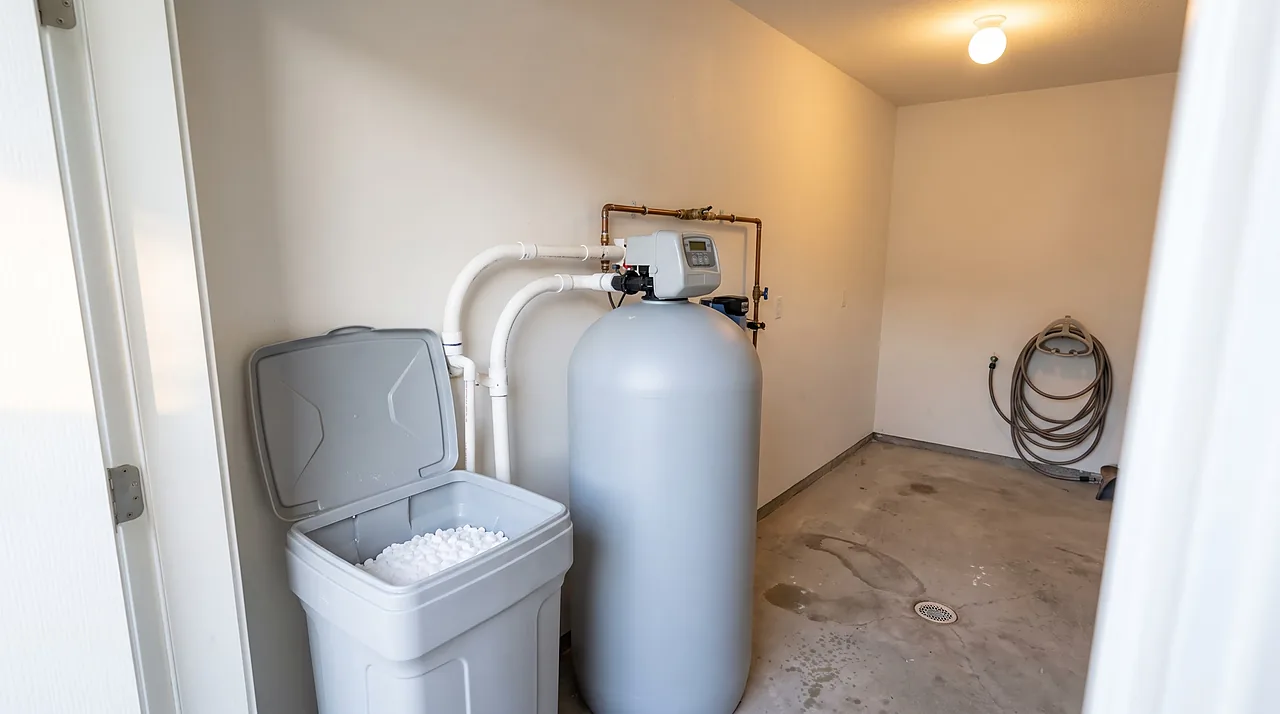
Most softeners have two tanks. The tall one, the resin tank, holds a bed of tiny plastic beads called resin. The shorter one, the brine tank, holds the salt. All-in-one cabinet models hide both inside a single box, but the parts are the same.
As hard water flows down through the resin, the beads grab calcium and magnesium and release sodium in their place. Soft water then flows out to the house. Like a sponge, the beads can only hold so much before they're full.
So every so often, about once a week on a well-sized softener, it cleans itself. This cleaning cycle is called regeneration. The control head, the valve on top of the resin tank, draws strong salt water from the brine tank through the beads. The salt knocks the calcium and magnesium loose, the softener flushes them down the drain, and the beads are ready again.
Regeneration usually runs around 2 a.m., takes about 85 to 110 minutes, and uses roughly 35 to 65 gallons of water. The tank-by-tank explainer follows the water through each stage. When you compare models, look for NSF/ANSI 44 certification. It means the softener was tested against a national standard for softening capacity, material safety, and structural strength.
Is your water hard enough to need one?

Hardness is measured in grains per gallon (gpg), the unit softener settings use. Water reports often list milligrams per liter (mg/L) or ppm instead, which are the same thing here. Divide that number by 17.1 to get gpg. The Water Quality Association groups the results like this:
- Under 1 gpg, soft. No softener needed.
- 1 to 3.5 gpg, slightly hard. You may see faint spots on glassware, but a softener rarely earns its cost.
- 3.5 to 7 gpg, moderately hard. Spots on air-dried glasses and more soap in the shower. It's a judgment call, unless you have a tankless water heater to protect.
- 7 to 10.5 gpg, hard. Chalky crust on aerators, hazy shower doors, and scale building inside the water heater. Most households here get clear value from a softener.
- Over 10.5 gpg, very hard. Scale builds fast, soap struggles to lather, and towels come out stiff. A softener is now about protecting your plumbing and appliances.
Get your own number before you shop. If you're on city water, ask the utility for its hardness figure. It may not appear in the annual water quality report, because no federal limit applies to hardness. Confirm it with your own test, since some cities blend sources. On a private well you'll need to test. Either way, it helps to know the figure before a dealer arrives with a test of their own.
Choosing one: four decisions, in order
- Work out the size. Softeners are rated in grains, the unit hardness is counted in. Start with your hardness in gpg. Add 3 to 5 gpg for every 1 ppm of clear-water iron, the dissolved kind that comes out of the tap clear and stains later. Multiply that by the people in your home, by 75 gallons a day each, and by 7 for the week. A family of four on 10 gpg water removes about 3,000 grains a day. That's 21,000 a week, and the softener should handle it with about one regeneration a week. The sizing guide walks through the math.
- Decide between salt-based and salt-free. A salt-based softener removes the hardness minerals. A salt-free "conditioner" changes them so they cling less as scale, but they stay in the water, so spots and weak soap lather usually remain. Here's how the two compare.
- Account for your source water. Chlorine in city water slowly breaks resin down. Well water often brings iron. A softener handles clear-water iron only up to about 1 to 3 ppm, depending on the unit. Above that, or with rusty red water, you need an iron filter in front of it.
- Pick the layout and the control head. Two-tank units are easier to service, while cabinet units fit tight closets but are cramped to work on. A widely used control head, such as the Fleck 5600SXT or Clack WS1, makes parts and independent service easy to find. That matters whether you buy from a home center or a dealer: a proprietary dealer control head can tie every future repair to that one company. How to choose covers the specs that matter, and compact softeners covers small spaces.
Watch the grain rating on the box. A softener sold as "32,000 grains" usually holds about 1 cubic foot of resin, and that big number assumes a wasteful salt dose. The Water Quality Association recommends settings that remove about 4,000 grains per pound of salt and warns against oversizing. At efficient settings, that same softener gives about 12,000 to 20,000 grains between regenerations. So the family of four above would outrun a "32,000-grain" box in less than a week. The label sells the tank. Your water bill and your salt bags pay for the settings.
Renting, or only want softer water in the shower? A portable softener connects to a shower arm or washer hose without cutting pipes. It treats one fixture at a time, and you regenerate it by hand with salt.
What it costs, up front and every month
A softener with professional installation typically runs about $1,000 to $3,000 in total. Homewyse puts a basic installation at about $1,131 to $1,405. Labor alone ranges from roughly $150 to $1,000, depending on how much plumbing has to change. Prices vary by region, so check current quotes. The line-item cost breakdown shows what each part of a quote should cover.
After that, the main cost is salt. A typical household uses 40 to 80 pounds a month, which is one or two 40-pound bags at about $7 to $12 each. That works out to roughly $7 to $24 a month. Each regeneration also sends 35 to 65 gallons of water down the drain.
The downsides worth knowing before you buy
- Added sodium. The resin trades hardness for sodium. According to North Dakota State University Extension, it adds about 8 mg/L of sodium for each gpg removed. At 10 gpg that's about 80 mg/L, or roughly 19 mg in an 8-ounce glass. For scale, a glass of milk has about 120 mg. If you'd rather avoid it, you can use potassium chloride or leave one cold kitchen tap unsoftened. The sodium math page runs the numbers for any hardness.
- Salt to carry, water to drain. Someone has to lift a 40-pound bag every few weeks, and every regeneration uses water. On a septic system, read what the research says before you install.
- It isn't a filter. Bacteria, nitrates, chlorine, and a rotten-egg smell all pass straight through. Here's what a softener doesn't remove.
- Keep it off the lawn. Outdoor faucets and irrigation lines should branch off before the softener, because sodium builds up in soil over time.
- A little upkeep. Five minutes a month, and a bigger clean every few years.
Living with one, day to day

The first week brings two surprises. The shower feels slippery, and your usual scoop of detergent buries the washer drum in foam. Neither is a fault. Soap lathers far more easily in soft water and rinses off differently, so your skin feels slick and you can cut back on detergent. The first 30 days covers what's normal and what to adjust.
After that, upkeep takes about five minutes a month. Lift the brine tank lid, keep the tank a quarter to half full of salt, and make sure the salt sits above the water line. Every two to three years, scoop out the sludge that settles at the bottom. The maintenance schedule has the full list, and the settings guide explains each number on the display.
When something stops working right
You usually notice it in the shower first. The soap stops lathering and the glass door turns cloudy again. Even then, the softener is rarely dead. Usually it's something cheap or free to fix:
- The bypass valve, the valve behind the control head that routes water around the softener, got bumped to Bypass during other work.
- The brine tank ran out of salt.
- A salt bridge formed, a hard crust that leaves the pellets hanging above the water.
- The clock reset after a power outage, so the softener regenerates in the middle of the day.
- The injector clogged. It's the small nozzle in the control head that pulls brine out of the tank, and cleaning it takes minutes.
The not-softening triage checks these in order, cheapest first, before you call anyone.
Read your water report
Read next


Questions people ask
What is the best water softener for a home?
The best one for your home is sized to your hardness and household, carries NSF/ANSI 44 certification, and uses a control head that's easy to get parts for. Brand matters less than those three. A softener that's too small regenerates every day or two, and one that's far too big can sit so long between regenerations that it wastes salt.
Do I need a plumber to install a water softener?
Not always. Some houses have a softener loop, pipe stubs left ready for a softener. If yours does, with a drain and an outlet nearby, a confident DIYer can connect one. If the main line has to be cut, copper soldered, or a new drain run, hire a plumber. Codes require an air gap, an open space between the drain hose and the drain, so wastewater can't be pulled back into your supply.
How long does a water softener last?
The resin usually lasts about 10 to 15 years on chlorinated city water, and longer on clean well water. Seals, o-rings, and floats wear out sooner, but they're inexpensive to replace. A failing older unit is a case for weighing <a href="/water-softener-repair-or-replace/">repair or replace</a>.
Do water softeners waste a lot of water?
It depends mostly on how the control head decides when to regenerate. A demand-initiated control head counts the gallons you use and regenerates only when the resin is nearly full. An old timer model regenerates on a fixed schedule, even after a week away. See <a href="/demand-vs-timer-regeneration/">demand versus timer regeneration</a>.
Do shower head water softeners work?
Most shower head "softeners" are filters, and they don't remove hardness the way a resin tank does. If you rent and want softer water in the shower, a portable resin softener is the closer match.
Sources
- U.S. Geological Survey, Water Science School
- Water Quality Association, "Getting Smart With Softeners"
- NSF International, "NSF/ANSI 44 Technical Requirements"
- North Dakota State University Extension, "Water Softening (Ion Exchange)"
- Homewyse, "Cost to Install Water Softener"