On this page
A whole-house cation-exchange water softener does not require five square feet of basement floor space. A compact cabinet softener such as Watercare's CareSoft Cabinet model fits a 14-inch by 20.5-inch floor footprint and stands 44.5 inches tall, small enough for an under-stairs nook or the side of a laundry closet. However, "compact water softener" covers three distinct hardware layouts (an all-in-one tank-in-tank cabinet, a slim twin-tank system, and a narrow 6- to 9-inch single mineral tank paired with a separate slim brine tank), and each trades away something different to save floor space. The other trade is capacity: a small resin tank has to suit the household's hardness and water use, which is the first thing to check.
Three footprints, not one
Before measuring your closet, identify which of the three physical configurations matches the shape of your open space:
The all-in-one cabinet

An all-in-one cabinet softener nests the resin tank directly inside the molded plastic salt storage bin, a layout Whirlpool's WHES40/WHES44 installation manual calls a "tank in tank unit." Those two models use a 9x40-inch or 10x40-inch resin tank holding 1 cubic foot of resin. Because there is no separate brine barrel, a cabinet softener occupies the smallest single rectangular footprint on the floor; Watercare's CareSoft Cabinet, for example, measures 14 inches wide by 20.5 inches deep by 44.5 inches tall and is marketed for under steps or inside closets.
The tradeoffs are salt handling and serviceability. The salt sits in a small enclosed well around the resin tank, and Whirlpool's manual advises keeping the salt level lower and refilling more often in humid areas to avoid salt bridging. Servicing the resin or the lower distributor also means working inside the cabinet rather than on a free-standing tank.
The slim twin-tank

A compact non-electric or metered twin-tank softener splits the resin volume across two narrower, shorter cylinders mounted side by side, fed by a separate brine tank. Pentair's Fleck 5600SXT valve, for one, can be programmed as a two-tank system that alternates which tank is in service. As detailed in our single-tank vs twin-tank comparison, while one tank softens water, the second sits regenerated on standby. The win is height, not floor area: two short tanks can fit under a low ceiling or shelf where one tall tank of the same total resin cannot, but together with the brine tank they take more floor width than a cabinet.
The narrow single tank

If your closet has normal ceiling height but only a skinny wall gap, you can pair a narrow mineral tank (a 7x44-inch tank typically holds about 0.5 cubic feet of resin, an 8x44-inch about 0.75) topped with a standard valve such as a Fleck 5600SXT or Clack WS1, alongside a slim brine tank. As confirmed in Pentair's Fleck 5600SXT service manual, that valve supports mineral tanks of 6, 7, 8, 9, and 10 inches in diameter by installing the matching color-coded injector nozzle (`#000 Brown` for 6-inch, `#00 Violet` for 7-inch, `#0 Red` for 8-inch, and `#1 White` for 9- and 10-inch tanks). Because the resin tank and brine tank are linked only by a flexible brine line, the two pieces do not have to stand side by side, which helps in an L-shaped or split space.
What each footprint actually delivers
Compare the space use, resin volume, and maintenance tradeoffs across the three compact layouts (usable grains follow the standard figure of about 20,000 grains per cubic foot at a 6 lb salt dose, or about 12,000 at the more efficient 3 lb dose):
| Compact Configuration | Floor Footprint | Height to Plan For | Typical Resin Volume & Usable Grains (at 6 lb/cu. ft.) | Primary Space Advantage & Key Tradeoff |
|---|---|---|---|---|
| All-in-One Cabinet ("Tank-in-Tank") | One box, e.g. 14" W x 20.5" D | Cabinet height (e.g. 44.5") plus room to open the salt lid | About 1 cu. ft. in the Whirlpool examples (about 20,000 usable grains) | Smallest single floor footprint; smaller salt well that needs more frequent checks, and harder to disassemble for valve or resin service. |
| Compact Twin-Tank System | Two tanks side by side plus a brine tank | Lowest of the three, because the resin is split between two short tanks | Split between two tanks; each tank's capacity is what lasts between regenerations (e.g. 0.5 cu. ft. per tank = about 10,000 grains) | Best for low overhead clearance; widest footprint and highest upfront equipment cost. |
| Narrow Single Tank + Slim Brine Tank | 6" to 9" diameter mineral tank plus a separate brine tank (can be apart) | Tank height plus the control valve on top, and room above to service the valve | 0.5 to 1.0 cu. ft. (about 10,000 to 20,000 usable grains) | Standard serviceable valve and flexible two-piece placement; needs the most ceiling height. |
Is a compact unit enough for your household?
Size by the daily grain load (people x 75 gallons x hardness in gpg), and aim for a regeneration about once a week. Compact cabinets are often sold on a big grain number that assumes the heaviest salt dose. Watercare's cabinet line, for example, is rated from 15,000 grains at 2.3 lb of salt up to 28,000 grains at 15 lb across its tank sizes, and the top figure is the wasteful maximum. As a rule of thumb, 1 cubic foot of resin gives about 12,000 grains at 3 lb of salt, about 20,000 at 6 lb, and 30,000 to 32,000 only at about 15 lb. Check our usable vs label grain capacity guide and household sizing formula before choosing.
- One or two people, moderate hardness: compact is usually enough
- 2 people x 75 gal x 10 gpg = 1,500 grains a day, or 10,500 a week. A 1-cubic-foot cabinet at the efficient 3 lb dose (about 12,000 grains) still reaches about a weekly cycle, and a 0.75-cubic-foot tank at 6 lb (about 15,000 grains) runs about 10 days.
- Three people on very hard water: workable, but it cycles twice a week
- 3 people x 75 gal x 18 gpg = 4,050 grains a day (28,350 a week). A 0.75 to 1.0 cubic-foot unit at 6 lb (about 15,000 to 20,000 grains) regenerates about every 4 to 5 days. That works, but every extra cycle costs roughly 35 to 65 gallons of water, so if the space allows, a 1.5-cubic-foot tank would get back to a weekly cycle.
- Four or more people, or well water with iron: usually too small
- 4 people x 75 gal x 12 gpg is already 25,200 grains a week before any iron (add 3 to 5 gpg per 1 ppm of clear-water iron). That outruns a 1-cubic-foot tank at an efficient dose, so look at a narrow single tank with more resin rather than a cabinet.
The clearance details a tank diameter doesn't tell you
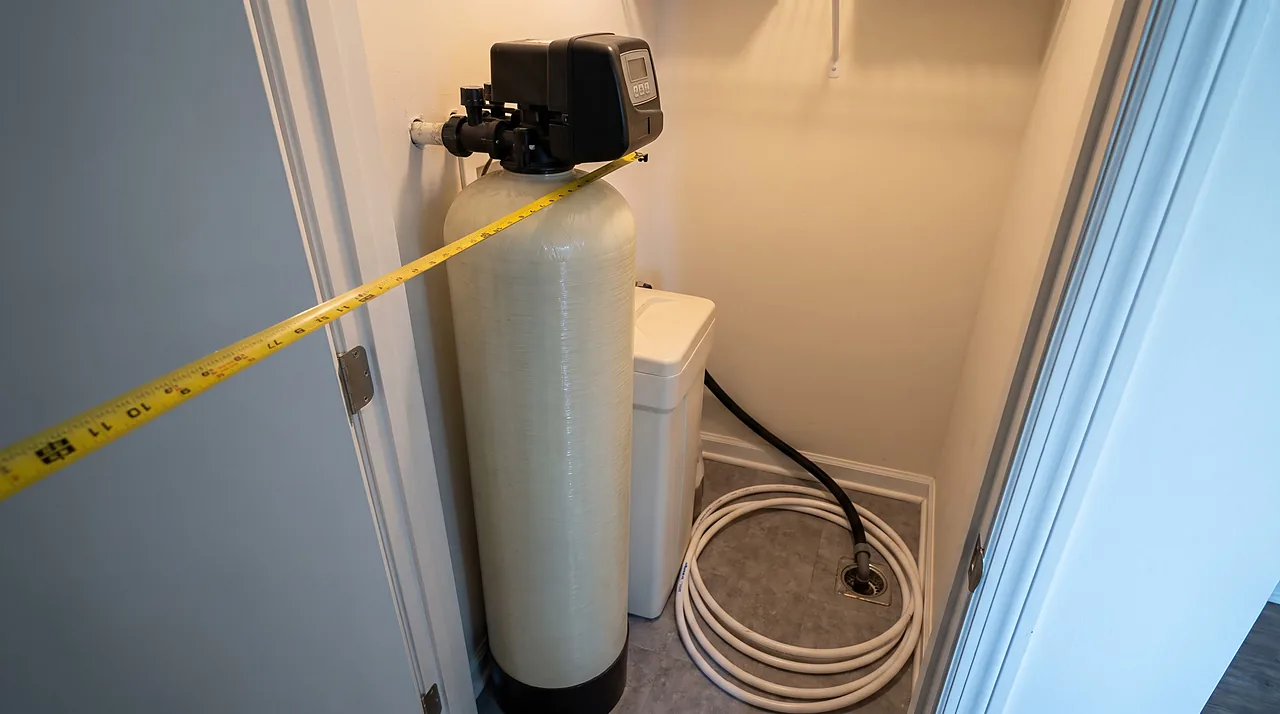
Before ordering any compact softener for a tight utility closet, check four physical installation details:
- Total height with the valve, plus room behind it: The control valve threads onto the top of a narrow tank and adds several inches of height, and the bypass valve and plumbing elbows stick out behind it. Use the assembled height from the unit's own spec sheet, not the bare tank size.
- Room above to open the lid and pour salt: A cabinet or brine tank needs enough clear space above it to open the lid and tip in a 40-pound bag without hitting a shelf or a wall-hung water heater.
- Indoor dry location and 20 psi minimum pressure: Per the Pentair Fleck 5600SXT manual, the electronic control head is rated "FOR DRY LOCATIONS ONLY" and requires at least 20 psi (1.4 bar) of operating water pressure for the regeneration valve to operate effectively.
- Drain line air gap: Even in a condo laundry closet, the drain line must terminate over a standpipe, laundry tub, or floor drain with an air gap equal to at least twice the drain pipe diameter (minimum 1 inch) to prevent back-siphonage. See where to install a water softener for code details.
Why the smallest brine well is the one you check most
A compact cabinet softener holds less salt than a separate full-size brine tank, so it runs low sooner, and its enclosed salt well is prone to salt bridging in humid utility closets. Whirlpool's cabinet manual advises keeping the salt storage level lower in humid areas and refilling more often, and to always add salt when it is below one-quarter full. In practice that means checking it at least monthly, keeping it one-quarter to one-half full with salt above the water line, and adding a partial bag at a time rather than filling to the rim. See our salt bridge troubleshooting guide if your salt level stops dropping.
Who this isn't for
All three compact footprints above require cutting into the main cold water pipe, plugging into a 120V outlet (except non-electric twin tanks), and routing a regeneration drain line. That holds for a condo or a mobile home too, so check the association rules or the landlord before you buy. A softener only treats the pipes downstream of it, so a "bathroom only" install still needs its own drain and salt access. Budget the same way as any softener install: system plus labor typically runs about $1,000 to $3,000 and labor alone about $150 to $1,000 (verify current local prices); the line items are in water softener installation cost. If you are renting an apartment where plumbing modifications are banned, see our portable apartment water softener guide instead.
Questions people ask
What is the smallest water softener you can get?
For a whole-house softener, the smallest layouts are an all-in-one cabinet (the Watercare CareSoft Cabinet, for example, is 14 by 20.5 inches and 44.5 inches tall) or a narrow mineral tank; Pentair's Fleck 5600SXT valve supports tanks down to 6 inches in diameter. Smaller still are portable softeners made for RVs and single fixtures, which need no permanent plumbing but treat far less water; they are covered in our portable and apartment softener guide.
Are portable water softeners worth it?
For a renter who cannot touch the plumbing, or for one fixture such as a washing machine, they can be. For a whole house they are too small, so an owner with room for even a cabinet unit is better served by a compact whole-house softener.
Is an all-in-one cabinet softener less reliable than a two-piece softener?
The ion-exchange process is identical, but cabinet softeners have two practical drawbacks: the small enclosed salt well is more prone to salt bridges and salt mushing in a humid space, and replacing the resin or servicing the lower distributor basket means working the resin tank out of the plastic salt cabinet. See our guide to cabinet water softener problems for details.
Can I put the brine tank in a different closet from the mineral tank to save space?
Yes, on any two-piece softener (such as a Fleck 5600SXT or Clack WS1). Because the two tanks are connected only by a flexible brine line, you can place the narrow mineral tank in the tight utility closet with the main water pipe and run the brine line to the brine tank nearby. Keep the run short and follow the valve maker's limits on brine line length and height.
How much resin capacity do I lose by dropping from a 10-inch tank to an 8-inch tank?
Cylinder volume scales with the radius squared, so the loss is bigger than the diameter suggests. An 8x44-inch tank typically holds about 0.75 cubic feet of resin (roughly 15,000 usable grains at a 6 lb/cu. ft. salt dose), a 9x48-inch tank about 1.0 cubic foot (about 20,000 grains), and a 10x54-inch tank about 1.5 cubic feet (about 30,000 grains).
Does a compact water softener use more salt per month than a standard softener?
Not because of its size. Salt used per grain of hardness removed is set by the salt dose per cubic foot, not by the tank size, so a compact tank on a demand-initiated (metered) valve at the same dose uses about the same salt per month for the same household. It simply regenerates more often with a smaller salt charge each time.
Read next


Sources
- U.S. Geological Survey, Water Science School
- Water Quality Association, "Getting Smart With Softeners"
- Pentair, "Fleck 5600SXT Downflow Service Manual"
- Whirlpool, WHES40/WHES44/WHESCS Installation and Operation Manual
- Watercare, CareSoft Cabinet Model product page