On this page
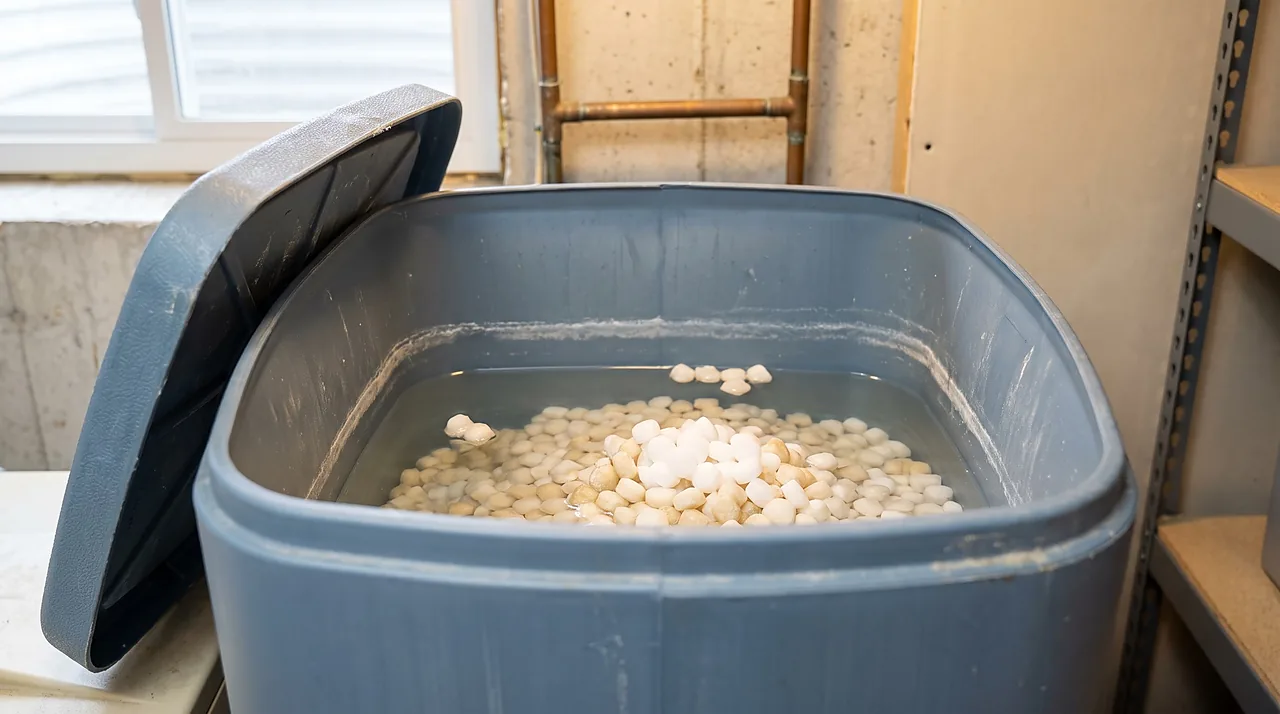
Finding 4 to 10 inches of standing water at the bottom of your water softener's brine tank is completely normal on standard post-refill systems (such as Fleck 5600SXT, GE, and Whirlpool units), provided you only see water when the salt pile has burned down low. However, if standing water has risen halfway up the tank and sits higher than the safety float (or covers two fresh bags of salt), the softener failed to draw brine during its last regeneration - caused by a clogged venturi injector, an air leak in the 3/8-inch brine tubing, a kinked drain line, or a stuck safety float.
Why there's always some water down there
Most residential water softeners use a "wet" (post-refill) brine tank: at the end of every regeneration cycle, the control valve runs a 6 to 16 minute Brine Refill stage that pumps 3 to 5 gallons of fresh water into the bottom of the salt tank so it can dissolve salt pellets into saturated brine for the next cycle. (Each 1 gallon of refill water dissolves roughly 3 pounds of salt.) Near the bottom of the tank sits a perforated salt grid platform, which the Water Quality Association notes is designed specifically so standing water can contact the lower layer of dry salt stored above.
When your tank holds one or two bags of salt, that 5 to 10 inches of water stays hidden underneath the dry pellets. Only when you let the salt run down near empty do you suddenly see the standing water reservoir at the bottom. By contrast, if your softener uses a "dry-tank" (pre-fill) setup - standard on many Kinetico and select Clack upflow configurations - the valve puts water into the brine tank only 2 hours before regeneration starts, so the bottom of a pre-fill tank should sit nearly dry between cycles.
The rule: height and timing, not presence
Use the actual height of the water line to tell a normal reservoir from a failed brine draw:
- Normal (4 to 10 inches of water at the bottom): Water sits below or level with a low salt pile and never rises past the bottom third of the tank. Add a bag of salt and leave it alone.
- Failed Brine Draw (water fills 50% to 75% of the tank, stopping at the safety float): During the last regeneration, the valve failed to suck the old brine out during Stage 2, then pumped another 3 to 5 gallons of refill water in on top of it during Stage 4 until the safety float shut off the line.
- Active Overflow (water spilling out the overflow elbow or over the top rim): Both the control valve brine seal and the safety float inside the brine well have failed to shut off incoming water pressure.
When it's climbing above the salt: three usual suspects

When water rises halfway up the brine tank and stays there, the valve is refilling the tank without ever drawing it down. Check these three components in order:
The injector isn't drawing brine
In 8 out of 10 high-water brine tanks, the culprit is a clogged venturi injector nozzle or injector screen inside the control valve. During Stage 2 (Brine Draw), water rushing through a pinhole-sized injector nozzle creates the vacuum that sucks the 3 to 5 gallons of brine out of the tank. If a grain of iron scale or sediment plugs that nozzle, Stage 2 sucks zero water out of the tank, and Stage 4 adds another 4 gallons of refill water on top of the old water. Follow our 10-minute vinegar soak in the injector cleaning guide to restore suction.
The float valve is stuck open (or the brine line has an air leak)
Open the round white brine well cap inside the salt tank and inspect the float assembly and the thin 3/8-inch tubing attached to its top stem. Two failures happen here: first, if the compression nut or push-fit collar on that 3/8-inch brine tube is loose or cracked, the injector sucks room air instead of water during Brine Draw, leaving the brine tank full. Second, if salt grit jams the safety float open, it cannot stop an overfill. Lift and drop the float by hand to confirm smooth travel, and see our full troubleshooting steps for the brine tank float.
The drain line can't keep up
The venturi injector can only create suction if wastewater can exit freely through the drain line. If the flexible drain tubing running to your standpipe, utility sink, or overhead rafters is kinked, frozen, or partially plugged with iron slime, backpressure builds inside the valve head during Brine Draw. Instead of sucking water out of the brine tank, the blocked drain forces water backward down the brine tube, filling the salt tank higher on every cycle. Inspect the entire drain path against our drain line setup and sizing checklist.
Reading the tank at a glance
- 4 to 10 inches of water visible only because the salt level ran low
- Diagnosis: Normal post-refill reservoir. Pour in 1 to 2 bags of salt pellets so dry salt sits above the water line.
- Water sits halfway up the tank (at the height of the safety float inside the brine well)
- Diagnosis: Clogged venturi injector or air leak on the 3/8-inch brine tube. Clean the injector nozzle and screen, tighten both ends of the brine line, and test the Brine Draw step manually.
- Water level climbs higher during the Backwash and Brine Draw steps instead of dropping
- Diagnosis: Kinked or restricted drain line forcing water backward into the brine tank. Straighten or flush the drain line and clean the drain line flow control button.
- Water rises past the safety float and spills onto the floor between regenerations
- Diagnosis: Leaking brine valve piston/seal inside the control head paired with a stuck safety float. Bypass the softener immediately and rebuild the valve seals and float.
The stop line: water actively reaching the floor
If brine is actively dripping from the side overflow barbed elbow or spilling over the rim onto your floor, push the softener's bypass valve into BYPASS immediately. A tank that continues filling while the control head is in normal `SERVICE` mode means pressurized water is leaking past a torn brine-refill seal inside the control head and bypassing a stuck safety float in the brine well. Once the bypass valve is closed, work through our leak troubleshooting guide.
A simple way to check without guessing

Instead of waiting 48 hours to see if the tank drains on its own, run our GrainsGone 5-minute Brine Draw test right now:
- Press a strip of blue painter's tape on the inside wall of the brine tank right at the current water line.
- Hold the
Extra Cycle/REGEN/RECHARGEbutton for 3 to 5 seconds to start a manual regeneration. - Once Stage 1 (Backwash) begins running water to the drain, press the button once more to advance the valve directly into Stage 2 (Brine Draw).
- Watch the water line against your painter's tape for 5 minutes. If the water level drops steadily below the tape (about 0.5 to 1 inch every few minutes), the injector and brine line have strong suction - let Stage 2 run until the tank drains down to the bottom air-check, then skip Stage 4 (Brine Refill) so it does not refill twice. If the water level does not drop a millimeter during Stage 2, shut the test down and clean the injector.
What this has to do with your salt use
Whenever a clogged injector or loose brine tube prevents Stage 2 from drawing brine out of the tank, the softener stops consuming salt altogether while the water level sits stuck at the safety float. If your household is not burning through the typical one to two 40-pound bags of salt every month or two, cross-check why the softener isn't using salt. And if years of undissolved rock-salt sediment have turned the bottom of that high-water tank into gray sludge, bail out the excess water and follow our full brine tank cleaning guide.
Read next


Questions people ask
How much water should be sitting at the bottom of a healthy brine tank?
On a standard post-refill softener (Fleck, Clack downflow, GE, Whirlpool), 4 to 10 inches of water (roughly 3 to 5 gallons, depending on your programmed salt dose) is normal at the bottom of the tank. When the tank is stocked one-quarter to one-half full of salt, that water sits below the top of the salt pile where you cannot see it.
I just poured in two bags of salt and now the water level looks much higher. Did something break?
Adding 80 pounds of solid salt pellets displaces the standing water at the bottom of the tank, pushing the water level up by several inches just like ice cubes in a glass. As long as dry salt still pokes above the water line and the water drops back down on the next regeneration, displacement is completely normal.
Should I bail the extra water out of a flooded brine tank before or after fixing the injector?
Fix the clogged injector or loose brine line first, then advance the control valve manually into Stage 2 (Brine Draw) and let the softener suck the excess water out to the drain by itself. Once the tank draws down to normal, fast-forward past Stage 4 (Brine Refill) back to Service so it does not add a fresh refill on top.
Why does the standing water in my brine tank look brownish or slightly cloudy?
Solar salt and rock salt contain natural mineral insolubles that tint standing brine water brownish-gray over time without hurting the resin bed. Switch to 99.8% pure evaporated salt pellets and scrub the brine tank out once every 2 to 3 years if sediment collects on the bottom floor.
Sources
- Water Quality Association (WQA), Glossary of Terms
- Fleck Systems (Fleck 5600SXT manufacturer specification page)
- Pentair
- Penn State Extension, "Water Softening"