On this page
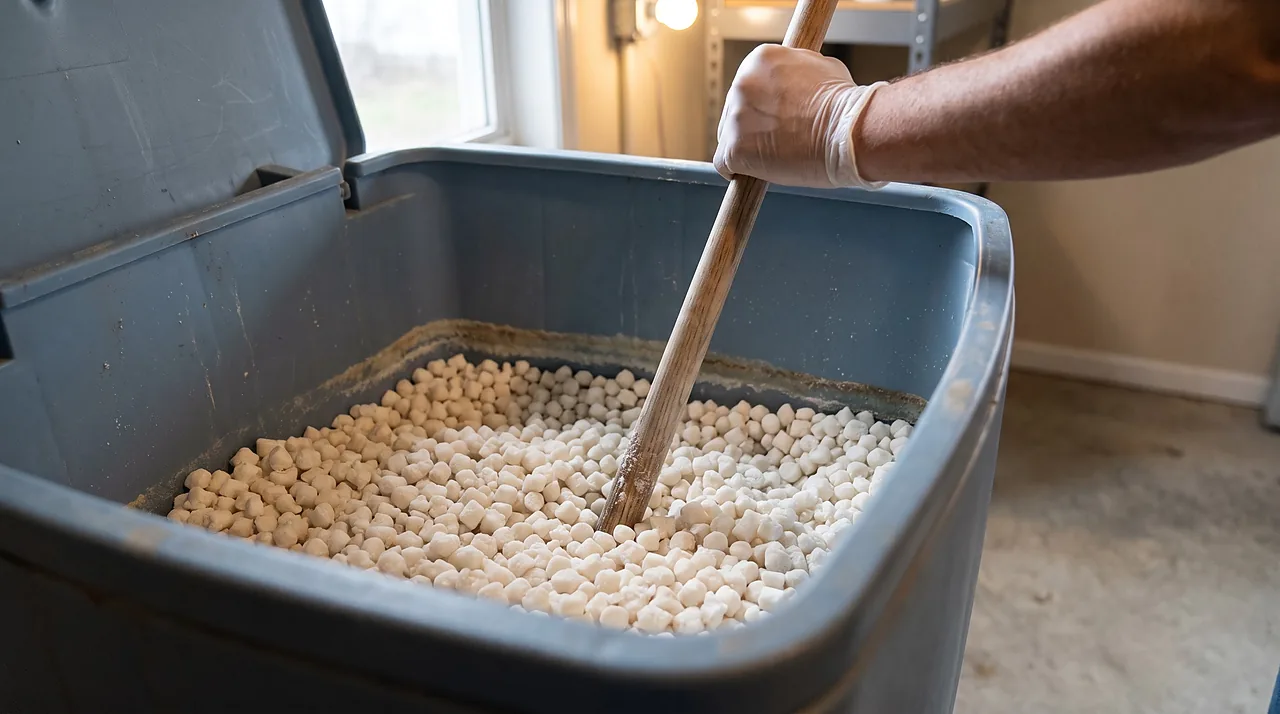
If the brine tank looks full but your water has turned hard again, push a broom handle straight down through the salt. If it stops on a hard layer partway down, that's a salt bridge. Break it gently with the handle and give the salt a couple of hours to make brine. Then run a manual regeneration, a cleaning cycle you start by hand.
It's an easy problem to miss. You lift the lid every month and the salt sits at the same comfortable level. Meanwhile the soap won't lather and the glasses come out of the dishwasher spotted.
What a salt bridge is

The brine tank is the shorter tank that holds the salt. On an all-in-one cabinet softener, it's the salt compartment around the resin tank. Either way, it keeps some water at the bottom, and salt sitting in that water dissolves into brine.
During regeneration, the softener's cleaning cycle, the control valve on top of the tall resin tank pulls that brine through the resin. The resin is the bed of beads that traps hardness, and the brine washes the hardness back out.
GE Appliances describes a salt bridge as salt "fused together to form a bridge or crust while underneath it is a mixture of salt water and empty space." Some people call it a salt clog or salt block. The crust grips the tank walls like an arch, the salt beneath it dissolves away, and the salt on top never reaches the water.
From above, the tank looks well stocked. Underneath, the valve is drawing weak brine or plain water, so the resin comes out of each cycle barely recharged. Each of those wasted cycles still sends roughly 50 gallons of water down the drain, by Penn State Extension's estimate. Two signs usually show up together:
- The water feels hard again: soap won't lather, spots appear, the shower feels different.
- The salt level hasn't dropped in weeks, even though a typical household goes through one or two 40-pound bags a month.
Checking for a bridge: the broom-handle test
You need a broom handle, or any long, blunt wooden or plastic pole. Skip metal bars and anything sharp, because the brine tank is plastic.
- Mark the depth first. Stand the handle against the outside of the tank, floor to rim, and put a piece of tape at the rim height. Now you'll know when the handle reaches the bottom.
- Push straight down near the center of the salt. Stay away from the tank walls and from the brine well, the tall tube inside the tank that houses the float.
- Feel where it stops. If the tape comes down to the rim, the handle reached the floor and there's no bridge. If it stops on something hard while the tape is still well above the rim, and it isn't a wall, that's the bridge.
Many tanks have a plastic platform a few inches off the floor, with the water around it. A stop that low, down at the water, is the platform. A bridge stops the handle well above the water.
Knocking on the side of the tank sometimes sounds hollow over the empty pocket. It's a hint at best, and the broom handle is the test that settles it.
Bridge, mush or something else: what the handle tells you

The same handle tells apart the four things that go wrong in a brine tank. Match what you felt:
- A hard stop partway down, then it breaks through into water or empty space
- A salt bridge. The same broom handle breaks it, with care for the tank walls.
- Loose salt, then a thick, gritty paste at the very bottom
- Salt mush, a sludge of fine salt and grit packed on the tank floor. Poking won't clear it, so it has to be scooped out, as described in salt mush, followed by a full brine tank cleaning.
- Loose salt all the way to the floor, yet the level hasn't moved and the water is hard
- No bridge. The softener isn't drawing brine. Common causes are a clogged injector, an air leak in the brine line, or a water meter that stopped counting. The injector is the small nozzle in the control valve that sucks brine up, and the brine line is the tube between the two tanks. Work through why the softener isn't using salt.
- Salt at or under the water line
- The tank is simply low. Add salt until it's a quarter to half full, wait a couple of hours, and run a regeneration.
Breaking a salt bridge, step by step
Budget about ten minutes of work, plus a couple of hours of waiting before the softener is useful again. The brine tank isn't under pressure, so there's no need to shut off the water.
- Scoop off the loose salt sitting on top of the crust and set it aside in a clean bucket. It's fine to reuse.
- Pour a little warm tap water over the crust if it's very hard, a gallon or so at most. It loosens the spots where the bridge grips the walls, and more water would only raise the level in the tank.
- Press down in the center with the handle. Use steady pressure and a twist until the middle gives way. GE warns against pounding or damaging the inside walls, so let the center take the force.
- Break up the slabs. Once the crust drops into the water, poke the big chunks into smaller pieces so they dissolve evenly. Lumps that won't break can go in the trash.
- Put the loose salt back and top up to a quarter to half full.
- Wait a couple of hours, so the fresh salt in the water has time to make strong brine.
- Run a manual regeneration. The button and its name vary by valve. The guides to the Fleck 5600SXT and the Clack WS1 show where to find it.
If the bridge starved the softener for weeks, run a second regeneration the next day to finish recharging the resin. Hot water can stay a little hard for a while after that, until the water heater has turned over its tank.
Why salt bridges form
High humidity and the wrong salt cause most bridges. A few habits make both worse:
- A damp room. Moist air dampens the top of the pile, and as it dries the pellets weld together. Garages and basements with big temperature swings are the classic spots.
- A tank filled to the rim. The upper salt sits in that damp air for months before it ever reaches the water.
- Low-grade salt. Rock salt and other impure salts clump more readily than clean pellets or crystals, as the guide to salt types explains.
- Potassium chloride. The Water Quality Association notes it forms salt bridges more readily than ordinary salt, so tanks using it need closer checks.
- Long stretches without regeneration, such as a vacation or a lightly used house, which leave the salt sitting still.
Keeping it from coming back

- Keep the tank a quarter to half full, adding one bag at a time instead of filling it to the top.
- Check once a month, and give the salt a quick poke with the broom handle while you're there. Pentair's maintenance guide lists digging out salt bridges as routine upkeep, and a thin crust breaks in seconds.
- Keep the lid on. If the room is damp, a dehumidifier helps the salt as much as the room.
- Use clean salt, either evaporated pellets or solar crystals.
- Clean the brine tank on a schedule. Pentair suggests about once a year, when the salt runs low anyway. Every two to three years is the outside limit, and sooner with rock salt.
Read next


Questions people ask
Can I just leave a salt bridge and wait for it to collapse on its own?
It may eventually fall in, but until it does the softener runs on weak brine and the water stays hard. Breaking it takes a few minutes, so there's no reason to wait.
Is hot water a good way to dissolve a bridge?
Hot tap water helps loosen a stubborn crust, but it won't dissolve a thick one on its own. Use a little to soften the edges, then break the crust with the handle. Boiling water isn't needed.
Do I need a special salt bridge tool?
No. Plastic breaker tools exist, but a wooden broom handle or a length of plastic pipe does the same job. Avoid metal bars, shovels, and screwdrivers, which can crack the plastic tank.
I already broke a bridge with a metal bar. Should I check anything?
Look over the tank walls and floor with a flashlight. Then keep a paper towel under the tank for a day or two after refilling, since a crack from a hard hit may only weep once water sits against it.
Is water in the brine tank a sign of a bridge?
Not by itself. Most brine tanks hold some water at the bottom by design, with dry salt sitting above it. Water that covers the salt points to a different problem, explained in <a href="/brine-tank-full-of-water/">brine tank full of water</a>.
Sources
- GE Appliances
- Pentair (Fleck)
- Water Quality Association, "Getting Smart with Softeners"
- Penn State Extension, "Water Softening"