On this page
- A two-minute check: the soap bottle test
- White crust on faucets and showerheads
- Shower glass that never stays clear
- Spots on dishes and glassware
- Soap that will not lather, and the film left behind
- Signs you can't see: the water heater and appliances
- How hard is yours? Match what you see to a range
- Next step: get a number, then decide
- Put a number on it
The surest signs of hard water are white, chalky crust on faucets and showerheads, cloudy spots on glasses, and soap that won't lather. If you see two or three of these, your water is probably hard. A free soap test confirms it, a test strip tells you how hard, and the symptom map shows what your level means.
Each sign comes from the same two minerals, calcium and magnesium. They're dissolved in the water, and they come out as a solid wherever water heats up or dries. That's why the worst spots in your home are the hot ones and the wet ones.
A two-minute check: the soap bottle test
- Fill a clean, clear bottle about a third full of cold tap water.
- Add a few drops of plain liquid soap, such as castile soap. Unscented soap with no added detergents works best.
- Cap it and shake it hard.
Soft water gives a thick head of bubbles and clear water underneath. Hard water gives thin, quickly fading suds and cloudy, milky water. If you have to keep adding soap to get a lasting foam, the water is hard.
The test only tells you hard or soft. It can't give you a number, and you need a number to size a softener. For that, use a strip or drop kit from the home hardness testing guide.
White crust on faucets and showerheads
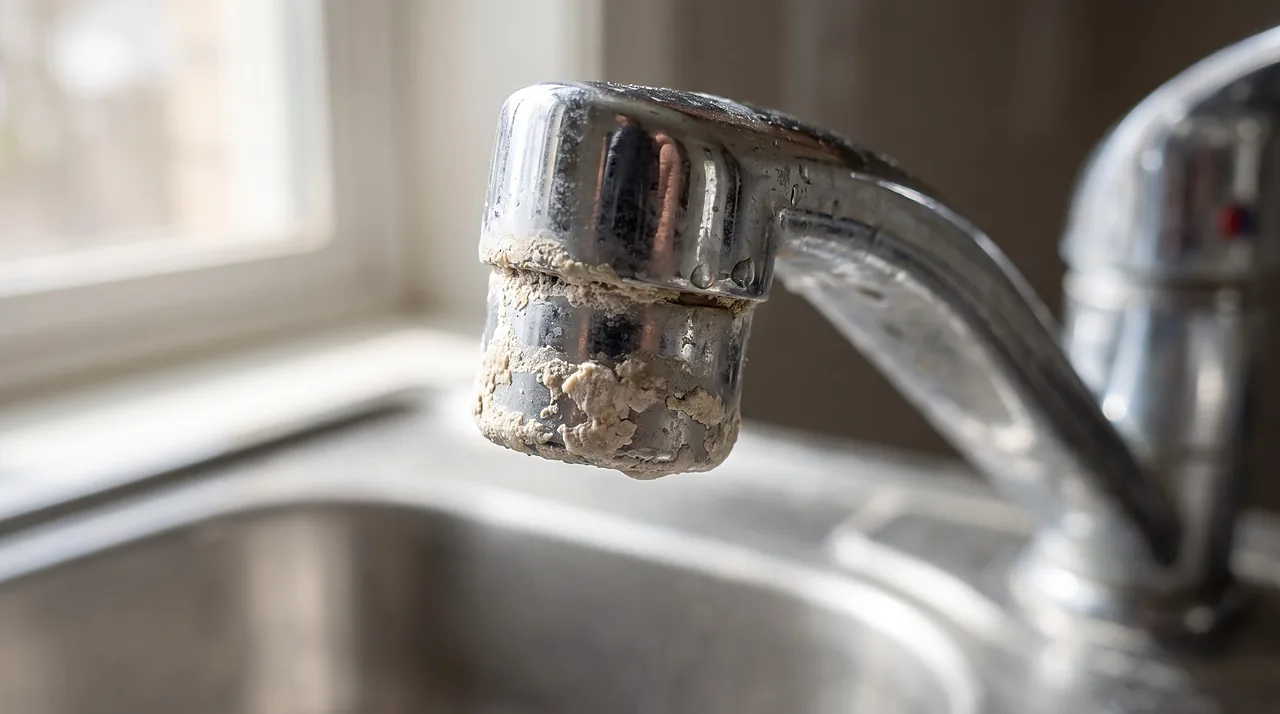
When tap water dries on a faucet, the dissolved calcium turns back into solid rock, the same stuff as limestone. It builds up as a white or tan crust called scale, or limescale, around the aerator, the small screen at the tip of the faucet. On a showerhead, scale blocks the tiny holes until one morning the spray shoots sideways at the wall instead of at you.
To confirm it's scale, wrap the crusty spot in a paper towel soaked in white vinegar for a few minutes. Leave thick crust longer. Scale softens, may fizz a little, and wipes away. Other colors and crusts point somewhere else:
- White crust that vinegar won't touch, even after a long soak, may be silica. A softener doesn't remove it.
- Orange or reddish-brown stains mean iron, not hardness. On a well, read about softeners and iron.
- Blue-green stains on a sink or tub usually come from acidic water slowly corroding copper pipes. That calls for a neutralizing filter, which is a separate fix from a softener.
Shower glass that never stays clear

Glass shower doors show hard water fast. Every morning they're hit with hot droplets and soapy runoff, and then they air-dry. The haze is a mix of scale spots and soap scum, and a mildly acidic cleaner removes most of it. Then you scrub the door on Saturday, and by Wednesday the cloudy film is back.
The trouble comes when that film is left for years. Scale can etch the glass itself, leaving a permanent frosted patch. A softener stops new spots, but it can't undo glass that's already etched.
Spots on dishes and glassware

A dishwasher's heat dries each drop on your glasses and silverware, and whatever minerals that drop held stay behind. The Water Quality Association lists mineral deposits on dishes and glassware as a standard sign of hardness. On mildly hard water, rinse aid helps the water sheet off. On hard water, you get white rings and cloudy film after almost every load, usually on the night you set the table for guests.
One trap: glasses that stay cloudy after a vinegar soak may be etched. The glass surface itself is worn, and no soak will clear it.
Soap that will not lather, and the film left behind

The Water Quality Association explains why hard water fights soap. The minerals react with it and form an insoluble, curdy solid, the gray soap scum you see on a bathtub wall. Instead of carrying dirt away, that curd sticks to whatever it touches. That leads to the signs people notice day to day:
- You need extra shampoo, body wash, or detergent to get suds.
- A gray ring forms along the tub and the shower floor.
- Towels and clothes come out stiff, scratchy, or dingy.
- Skin feels tight or slightly tacky after a shower.
- Hair can feel coated or dull.
Those effects on skin and hair are cosmetic, a matter of feel and residue. They usually ease once the water is softened, because no calcium or magnesium is left to form the curd.
Taste can be a clue too. Hard water may taste slightly chalky. A rotten-egg smell or a metallic taste points to sulfur or iron instead. A softener isn't built to fix those; see what a softener doesn't remove.
Signs you can't see: the water heater and appliances
Scale has an odd habit. It comes out of water faster as the water gets hotter, so the hottest surfaces in your home collect it first. In a water heater, that means the heating element of an electric tank, the tank bottom over a gas burner, or a tankless heat exchanger.
You can see a preview in the kitchen. Look inside your kettle or the coffee maker's water reservoir. A white, rough coating on the bottom is the same scale that's building in the water heater.
Does your water heater pop or rumble while it heats? That's usually water trapped under scale or sediment at the bottom of the tank, boiling and bursting through. Scale also coats the dishwasher's heating element and the holes in its spray arms. Over time it narrows showerheads and the small passages in faucets and appliances, so flow drops. A tankless water heater is especially sensitive, which is why the tankless water heater guide covers when to soften for one.
How hard is yours? Match what you see to a range
Water hardness is measured in grains per gallon (gpg). Lab reports often use milligrams per liter (mg/L) or ppm instead. Divide that number by 17.1 to get gpg, so 171 mg/L is 10 gpg. Using the Water Quality Association's ranges, here's roughly what each level looks like in a home:
- Under 1 gpg: soft
- Soap lathers easily, and fixtures stay clean. No softener needed.
- 1 to 3.5 gpg: slightly hard
- Faint spots on air-dried glasses and dark counters, and a light film in the kettle after months of use. A softener rarely earns its cost here.
- 3.5 to 7 gpg: moderately hard
- A soap ring in the tub, extra detergent for the same suds, and a white film that slowly builds on faucet tips. It's a judgment call whether to soften.
- 7 to 10.5 gpg: hard
- Crust you can feel on faucets, clogged showerhead holes, cloudy dishwasher glasses even with rinse aid, and scale building in the water heater. Most homes here benefit from a softener.
- Over 10.5 gpg: very hard
- Shower glass hazes over within days, aerators crust up fast, and the water heater may start to rumble. A softener is now about protecting your plumbing and appliances.
Treat this as a first guess. How fast scale builds also depends on how hot your water runs, how much you use, and how often you clean.
Next step: get a number, then decide
Symptoms tell you whether to look closer. A number tells you what to do. Test your water at home, or ask your water utility for its hardness figure and convert it from ppm to gpg.
To fix hard water for the whole house, the standard answer is a salt-based softener, which removes calcium and magnesium. Salt-free conditioners are sold to reduce scale but leave the minerals in the water, so spots and soap scum usually remain. If your number is 7 gpg or more, start with what size softener you need. The water softener guide covers the rest, from cost to downsides.
Put a number on it
Read next


Questions people ask
Which states have the hardest water?
Hardness follows geology, so it can change from one town to the next within the same state. Groundwater that passes through limestone and similar rock picks up a lot of calcium, which is why well water is often harder than city water drawn from rivers or lakes. No state list replaces a test or a call to your utility.
Is hard water bad for your hair?
It's a cosmetic question. Many people notice it right after washing, when hair feels stiff or hard to rinse, because shampoo reacts with the minerals and leaves a residue. Softened water doesn't form that residue, so hair usually rinses cleaner within a few washes.
What does soft water feel like?
Slippery. Soap lathers with very little product and takes longer to rinse off, so your skin feels slick after a shower. You'll also see the signs of hard water fade: glass and faucets stay clear, the kettle stays clean, and the same suds take less soap.
Can hard water get worse at certain times of year?
Yes. Some cities blend water from different sources, such as a river and deep wells, and change the mix with the season. If your fixtures suddenly crust up faster, test again or check the latest water quality report.
Does a refrigerator or pitcher filter fix hard water?
Most don't. Standard carbon filters target chlorine taste and smell and leave calcium and magnesium alone. Even a pitcher with a small softening cartridge only treats the water you pour, while the shower, laundry, and water heater still get hard water.
Sources
- U.S. Geological Survey, Water Science School - "Hardness of Water"
- U.S. Geological Survey, Open-File Report 2015-1080
- Water Quality Association (WQA), "Scale Deposits"