On this page
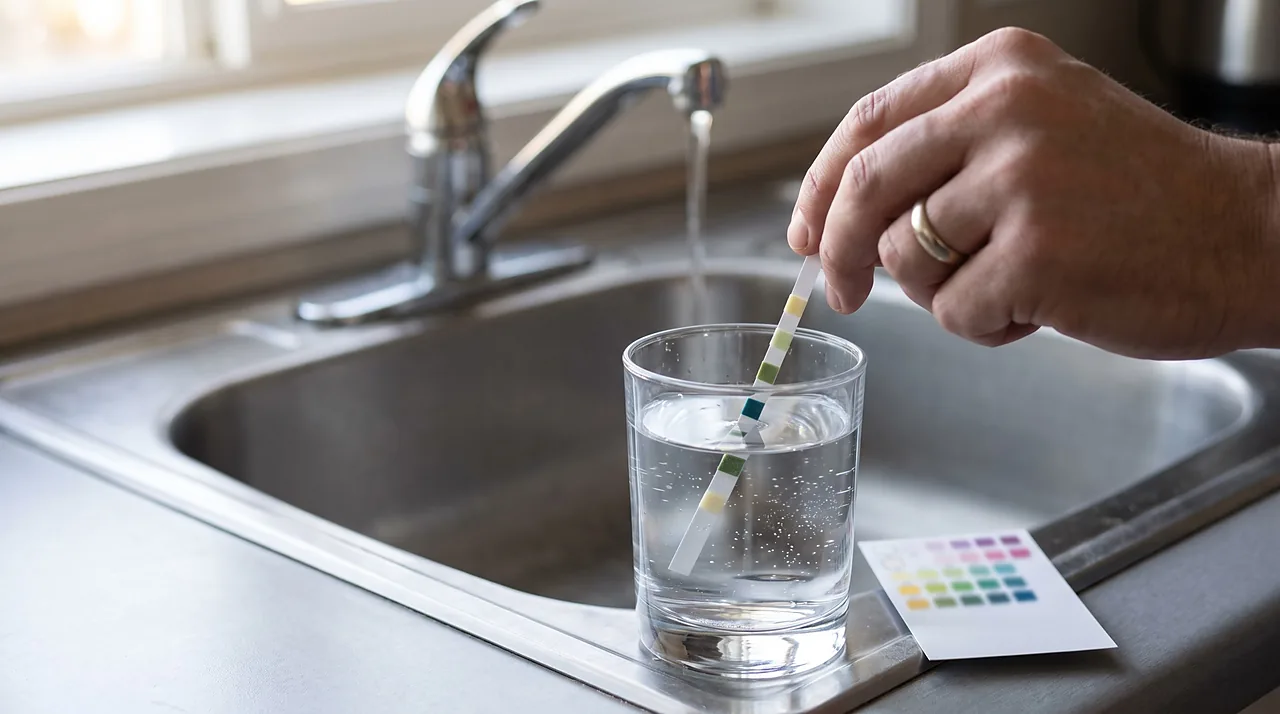
Test the exact same kitchen tap with a $9 bottle of dip strips, a $20 drop-count titration kit, and a certified drinking-water lab, and you will get three different levels of resolution. Dip strips read in wide color jumps (such as 0, 3, 7, 15, and 25 grains per gallon), whereas a drop-count titration kit or lab test gives you an exact grain-per-gallon (gpg) figure you can actually type into a water softener's control head.
As the University of Nebraska-Lincoln Extension notes, home test kits and dip strips are inexpensive and provide a solid estimate, while laboratory testing delivers the highest accuracy. Picking the right test depends on whether you are just confirming visible hard-water symptoms or sizing and programming a $1,500 system.
Four ways to get a number, compared

Here is how the four testing methods stack up by cost, turnaround time, and precision (verify current kit pricing and strip graduations on the package you buy):
| Testing method | Typical cost | Time to result | Resolution & precision | When to use it |
|---|---|---|---|---|
| 1. Color-match dip strips | $8 - $12 (pack of 50) | 15 - 30 seconds | Broad color steps (often +-3 to 5 gpg error at higher hardness) | Quick yes/no check on whether water is hard, or checking if an existing softener is still outputting 0-1 gpg soft water |
| 2. Drop-count titration kit (EDTA reagent) | $15 - $28 | 2 - 3 minutes | +-1 gpg per drop (crisp pink-to-blue color shift) | Best home choice for sizing a new softener and programming your valve's Hardness (H) field |
| 3. Free in-home dealer test | $0 (sales visit) | 10 - 15 minutes | Usually a real drop-count titration, but interpreted by a commissioned salesperson | Getting a baseline quote - always cross-check with your own $20 drop kit before buying |
| 4. Certified water testing lab | ~$20 for hardness ($50 - $150 full well panel) | 5 - 10 business days | Exact mg/L (ppm) and gpg plus iron, manganese, pH, and TDS | Private wells (EPA recommends annual certified lab testing for wells) or complex water with staining and odors |
Penn State Extension points out that a standalone hardness test at an accredited water lab typically costs about $20. Because hardness is an aesthetic nuisance rather than a health-regulated contaminant, municipal utilities are not legally required to list it in their annual Consumer Confidence Report (CCR) - though many publish it on their website or provide it if you call the water department.
How a drop-count titration kit works (and why water techs use it)
If you want an exact number today without mailing a bottle to a lab, skip paper dip strips and order a standard drop-count titration kit (such as the industry-standard Hach 5-B total hardness test). Instead of asking you to guess whether a wet paper pad looks more like "brick red" or "magenta," titration uses a sharp chemical endpoint:
- Fill the plastic measuring tube to the line with cold untreated tap water and pour it into the mixing bottle.
- Add a few drops of buffer/indicator solution (or a reagent powder pillow) and swirl. If hardness minerals are present, the water turns a distinct pink or wine-red. (If it turns pure blue immediately, your water is already 0 gpg soft.)
- Add the EDTA titrant solution one drop at a time, swirling between drops and counting each drop out loud, until the water shifts sharply from pink/purple to pure sky blue.
- The count is your gpg: Every 1 drop required to turn the sample blue equals 1 grain per gallon (gpg) of hardness. Twelve drops = 12 gpg.
Two things that quietly wreck a home reading

Even a lab-grade titration kit will hand you a bad number if the water sample is drawn carelessly:
- Sampling downstream of an existing softener or from the hot tap: If your house already has an old softener installed, testing at the kitchen sink measures the softener's output, not your raw supply. Always draw your raw-water test sample from an outdoor garden hose spigot plumbed ahead of the softener, or switch the softener's bypass valve to BYPASS and run the cold tap for two full minutes before filling the vial. Never test hot water, as water heaters precipitate calcium onto their elements and skew the reading.
- Iron interference on well water: Dissolved clear-water (ferrous) iron reacts with hardness indicator dyes and can make a titration endpoint look muddy purple or shift a dip strip reading upward. If you are on a private well, the U.S. Environmental Protection Agency recommends testing through a certified lab for bacteria, nitrates, TDS, and pH every year, and adding hardness and iron whenever you see scale or staining.
One kitchen tap, three tests

To see why resolution matters on GrainsGone, take a household whose true raw water hardness is 14 gpg (240 mg/L):
- The dip strip lands somewhere between the "7 gpg (120 ppm)" pad and the "15 gpg (250 ppm)" pad. Under yellow kitchen lighting, two people in the same house might read it as 9 gpg or 18 gpg - a gap wide enough to mis-size a softener by a full tank tier.
- The drop-count titration kit turns from pink to pure blue on the 14th drop (14 gpg), giving the exact integer needed for the valve display.
- The certified lab report returns 239 mg/L as CaCO3, which divides by 17.1 to confirm 14.0 gpg alongside an exact iron reading in ppm.
What the number means once you have it
Once you have your reading, compare it against the two standard scales. The U.S. Geological Survey groups water in mg/L (ppm) into four bands: soft (0 to 60 mg/L), moderately hard (61 to 120 mg/L), hard (121 to 180 mg/L), and very hard (over 180 mg/L). The Water Quality Association and UNL Extension express those same breakpoints in grains per gallon: soft (0 to 1 gpg), slightly hard (1 to 3.5 gpg), moderately hard (3.5 to 7 gpg), hard (7 to 10.5 gpg), and very hard (10.5+ gpg).
If your lab or utility report arrived in mg/L or ppm, use our ppm-to-gpg conversion guide (divide mg/L by 17.1). Then plug your gpg figure directly into our water softener sizing formula or enter it into your valve using our hardness setting walkthrough (and review what a softener does not remove if your lab panel flagged other contaminants).
Convert your result
Questions people ask
How often should I retest my water hardness?
On municipal water, testing once at installation and once a year afterward (to verify your softener is still producing 0-1 gpg soft water at the cold tap) is plenty, unless your city switches water sources. On a private well, retest raw hardness and iron every 1 to 2 years, as aquifer mineral levels can shift with drought or heavy rainfall.
Why doesn't my city's annual water quality report list water hardness?
The EPA mandates Consumer Confidence Reports (CCRs) only for health-regulated contaminants with Maximum Contaminant Levels (like lead, nitrates, and coliform). Because calcium and magnesium hardness is a plumbing and aesthetic issue with no federal limit, some utilities leave it off the main chart - call your water utility's lab desk or check their secondary parameters table online.
What do sales reps add to the water during an in-home "soap shake test"?
During a classic sales demonstration, a rep puts drops of pure Castile soap solution into a vial of your raw tap water and shakes it (producing cloudy soap curd and no foam), then repeats it on water passed through a pocket demo softener (producing tall suds with 2 drops). That demonstration only proves your water has >3 gpg of hardness; always ask for the exact numerical drop-count titration reading in gpg.
Can old test strips give a false reading?
Yes. Reagent pads on dip strips degrade rapidly once the plastic bottle is opened and exposed to bathroom or basement humidity. Always check the expiration date stamped on the bottle and keep the cap sealed tightly with the desiccant packet inside.
Read next


Sources
- U.S. Geological Survey, Water Science School
- University of Nebraska-Lincoln Extension, "Drinking Water: Hard Water" (G1274)
- Penn State Extension, "Water Tests for Households Using Public Water Supplies"
- U.S. Environmental Protection Agency, "Protect Your Home's Water"