On this page
A water softener trades the hardness in your water for sodium. Hard water flows through a tank of tiny resin beads that grab calcium and magnesium and let go of sodium. Every few days to once a week, the softener rinses those beads with salt water and flushes the hardness down the drain.
Every other part on the unit, from the second tank to the valve on top, either runs that trade or reloads the beads once they're full. Here's what happens at each step, while you use water during the day and while the softener cleans itself at night.
The swap inside the resin tank
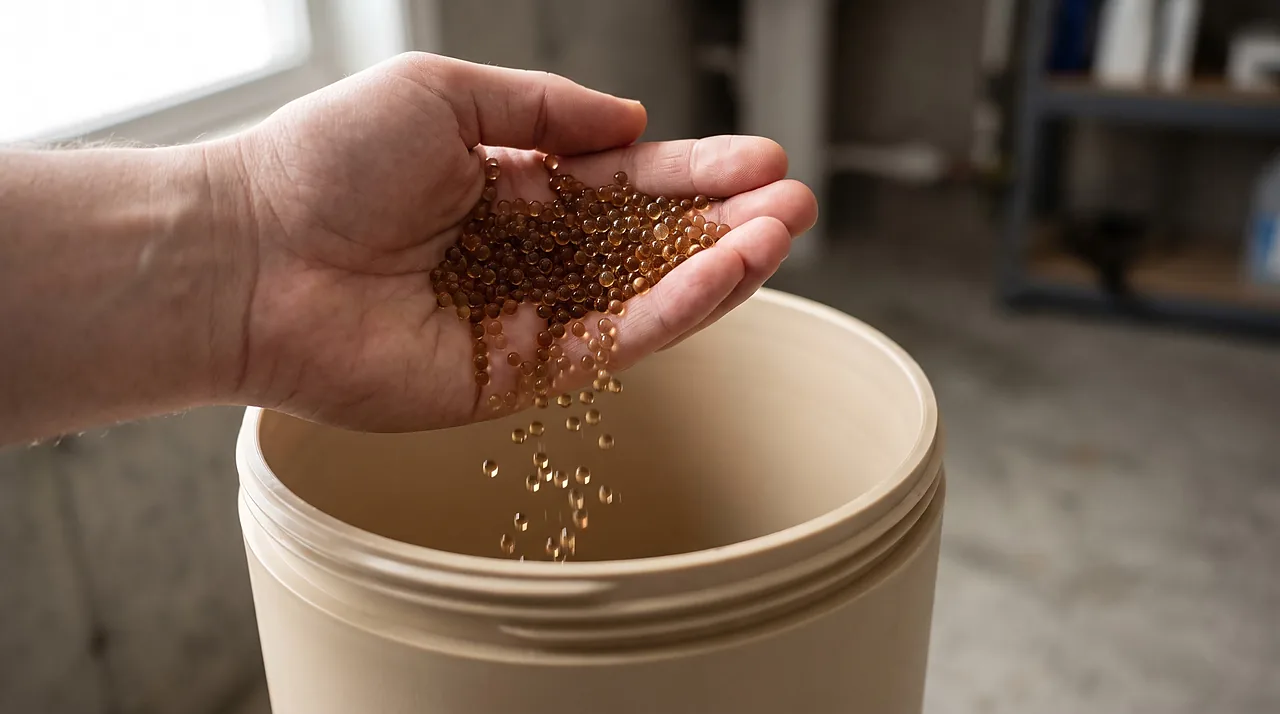
The tall tank is the resin tank. It's filled with resin, millions of amber plastic beads about the size of a pinhead. Each bead carries a negative electrical charge, and after a cleaning cycle those charged spots are holding sodium.
Calcium and magnesium, the minerals that cause scale and soap scum, carry a stronger positive charge than sodium. So as hard water flows down through the beads, the resin grabs the calcium and magnesium and releases the sodium into the water. The University of Nebraska-Lincoln Extension describes it this way: the hardness attaches to the beads, and the loosely held sodium is set free.
By the time the water reaches the bottom of the tank, the hardness is stuck to the resin. Soft water flows up a pipe in the middle of the tank and out to your faucets.
What's inside the two tanks (and the head that runs them)

A two-tank softener in a basement and an all-in-one cabinet unit in a laundry closet look different from the outside. Inside, both have the same four parts.
- The resin tank
- The tall tank, connected to your main water line and under full household pressure. Resin fills most of it. Many tanks also have a layer of gravel at the bottom to spread the flow evenly.
- The riser tube and distributor
- The riser tube is a plastic pipe running down the center of the resin to a slotted basket at the bottom, called the distributor. Its slots are narrow enough to hold the beads back. Soft water enters the slots and rises up the tube to the house. If the riser cracks, hard water can slip past the resin, or resin beads can turn up in your faucets.
- The brine tank
- The shorter tank, not under pressure, holding salt or potassium chloride. A few inches of water at the bottom dissolve the salt into brine, a strong salt solution. A float inside works like the one in a toilet tank and shuts off the water if the level ever gets too high.
- The control head
- The valve on top of the resin tank, such as a Fleck 5600SXT or Clack WS1. On most modern units it has a small meter that counts every gallon you use, plus a motor that reroutes the water during cleaning. The settings guide explains what each number on its display does.
What happens during regeneration

The beads only have so many charged spots. Once they're full of calcium and magnesium, hard water starts slipping through to your taps. Before that happens, the control head runs a cleaning cycle called regeneration.
On a demand-initiated softener, the kind that counts gallons, the control head tracks how much hardness the resin has taken in. When the resin nears its capacity, the most it can hold, the control head schedules a regeneration. It runs at a quiet hour, usually around 2 a.m.
The whole cycle takes about 85 to 110 minutes and sends roughly 35 to 65 gallons of water down the drain. It runs in five stages:
- Backwash. Water flows backward, up through the resin. This lifts and loosens the packed beads and flushes out sediment and specks of iron. It's the loud part. If you've ever heard water rushing in the basement in the middle of the night, this was it.
- Brine draw. Water rushing through the injector, a tiny nozzle in the control head, creates suction. That suction pulls brine out of the brine tank and through the resin. Flooded with sodium, the beads let go of the calcium and magnesium and reload with sodium.
- Slow rinse. Fresh water follows slowly behind the brine, pushing it through the rest of the resin. The loosened calcium and magnesium go with it, out to the drain.
- Fast rinse. A quick, strong flush packs the beads back into place and washes away the last of the salty water.
- Refill. The softener returns to normal service and sends a measured amount of fresh water into the brine tank. Within a few hours, that water dissolves enough salt to make brine for the next cycle.
Most single-tank softeners let water bypass the resin while they regenerate, so you never lose water completely. But anything you draw during the cycle is untreated. If the dishwasher kicks on at 2:30 a.m., it gets hard water. That's why the cycle is set for the middle of the night.
Where the salt goes
Most of it goes down the drain. The salt dissolves into brine, the brine washes through the resin, and the sodium knocks the hardness loose. All of the chloride, any sodium the beads didn't take up, and the loosened calcium and magnesium are rinsed out together. The rest is the sodium the beads hand to your water as they soften it.
That amount depends on how hard your water was. Hardness is measured in grains per gallon (gpg), the unit softeners use; 1 gpg is 17.1 mg/L. UNL Extension puts the added sodium at about 8 mg/L for each gpg removed. Softening 10 gpg water adds about 80 mg/L, or roughly 19 mg in an 8-ounce glass.
Mayo Clinic says a glass of softened water generally contains less than 12.5 mg of sodium. That matches water that started out below about 6.6 gpg. The sodium math page works it out for any hardness. If you'd rather avoid the added sodium, you can use potassium chloride in the brine tank or leave one cold kitchen tap unsoftened.
How long a 40-pound bag of salt lasts
A typical household uses 40 to 80 pounds of salt a month, so one bag lasts roughly two to four weeks. Harder water, a bigger family, and a higher salt setting all use it faster. Check the brine tank once a month, and keep it a quarter to half full, with the salt sitting above the water line. How much salt to use covers the details.
Why the salt setting changes capacity
How much hardness the resin holds between regenerations depends on how much salt each regeneration uses. For one cubic foot of resin:
| Salt per regeneration | Grains it can hold | Grains per pound of salt |
|---|---|---|
| 3 pounds | about 12,000 | about 4,000 |
| 6 pounds | about 20,000 | about 3,300 |
| about 15 pounds | about 30,000 to 32,000 | about 2,000 |
The bottom row is the "32,000 grains" printed on the box of a one-cubic-foot unit, and it wastes salt. NSF/ANSI 44, the national certification standard for softeners, has an efficiency rating that sets the bar higher. A certified efficient model must regenerate on demand and remove at least 3,350 grains per pound of salt. It also can't use more than 5 gallons of water for every 1,000 grains it removes. Only the low setting clearly clears that bar.
Here's how it plays out. A family of four uses about 75 gallons each per day. On 10 gpg water, that's 4 x 75 x 10 = 3,000 grains a day, or 21,000 a week. A one-cubic-foot softener set at 6 pounds holds about 20,000 grains, so it regenerates about once a week. The sizing guide runs the same math for your house, and the grain capacity guide explains the salt trade-off. Demand versus timer regeneration compares the two ways a softener decides when to clean itself.
Why the resin eventually wears out
Resin goes through hundreds of regenerations and typically lasts about 10 to 15 years on city water. Two things shorten that. Chlorine in city water slowly breaks the beads down until they swell, turn mushy, and choke the water flow.
Iron is the other. A softener can take out small amounts of clear-water iron, the dissolved kind, up to about 1 to 3 ppm depending on the unit. Over time it coats the beads, and a resin cleaner strips it off. Red, rusty water and iron bacteria are beyond a softener and need a dedicated iron filter. On clean well water, resin often lasts longer than on city water.
What softening does not do

Softener resin only trades positively charged minerals like calcium, magnesium, and small amounts of clear-water iron. Plenty of other things pass straight through the tank:
- chlorine taste and smell
- nitrates and PFAS, the so-called forever chemicals
- hydrogen sulfide, the rotten-egg smell
- bacteria
- total dissolved solids, since the softener swaps minerals rather than removing them
That's why many homes on city water add a carbon filter. For drinking water contaminants, people often put a reverse osmosis filter at the kitchen sink. The full breakdown is in what a water softener doesn't remove. For the trade-offs of owning one, from hauling salt to septic questions, see the water softener guide.
Every guide in Hard water explained
Read next


Questions people ask
How does a water softener know when to regenerate?
A demand-initiated softener counts the gallons you use with a meter in the control head and regenerates once they add up to its capacity. An older timer model regenerates on a fixed schedule, whether you used much water or not, so it tends to waste salt and water.
Does a water softener need electricity?
Most do, to power the control head's clock, display, and motor. Some twin-tank models run without electricity, using the flow of water to turn the valve. See <a href="/twin-tank-water-softener/">single-tank versus twin-tank softeners</a>.
What is the downside of a water softener?
Mostly upkeep and running cost. Someone has to haul and pour the salt, at about $7 to $12 per 40-pound bag (prices vary, so check locally), and each regeneration sends 35 to 65 gallons down the drain. Outdoor irrigation lines should stay unsoftened, because sodium builds up in soil. Buying and installing one typically costs about $1,000 to $3,000; the <a href="/water-softener-installation-cost/">installation cost breakdown</a> has the details.
Why is there always water in the bottom of the brine tank?
Because the softener puts it there on purpose. At the end of each cycle it refills the brine tank with a measured amount of water, which dissolves salt into brine for next time. That's normal as long as the salt sits above the water line.
Can I switch from salt to potassium chloride?
Yes, in the same brine tank with no changes to the plumbing. Potassium chloride regenerates the resin a little less efficiently than salt, so check your valve manual for a higher salt setting. The <a href="/potassium-chloride-water-softener/">potassium chloride guide</a> covers the cost difference.
Sources
- University of Nebraska-Lincoln Extension, "Drinking Water Treatment: Water Softening (Ion Exchange)"
- U.S. Geological Survey, Water Science School, "Hardness of Water"
- Mayo Clinic, "Water softener: Will it affect my blood pressure?"
- NSF International, "NSF/ANSI 44 Technical Requirements"
- Water Quality Association, "Ion Exchange" fact sheet