On this page
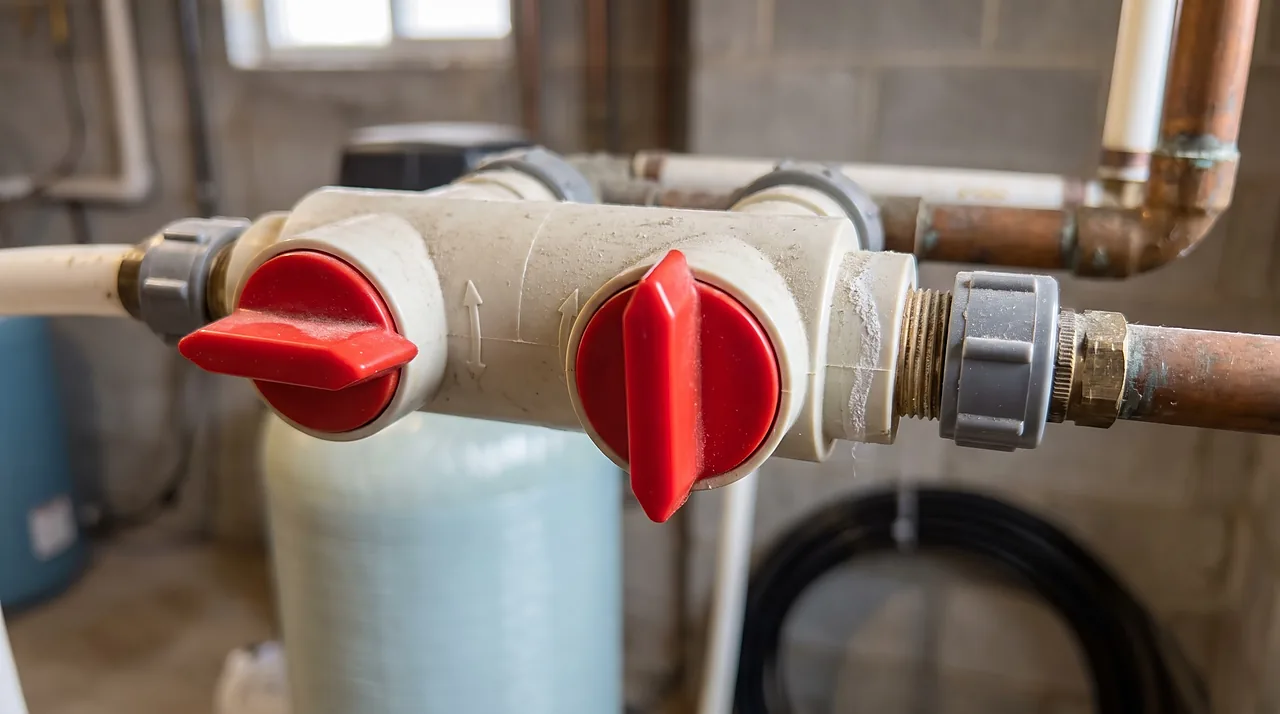
A water softener bypass valve sits directly behind the control head where the inlet and outlet water pipes connect to the tank. Its job is to divert incoming water straight to your house plumbing without passing through the resin bed whenever you are filling a swimming pool, watering a lawn through an un-bypassed spigot, flushing a hot water heater, or repairing the softener head. Because residential softeners use four different mechanical bypass designs, knowing how to read your specific handle or plunger orientation takes the guesswork out of whether your tank is actually in Service or Bypass.
Service position: the one it should be in almost all the time
In the Service (Normal Operation) position, untreated hard water enters the right-hand inlet port (when facing the front of a Fleck or Clack control head), flows down through the cation-exchange resin bed, and exits out the left-hand outlet port to the house. You do not need to touch the bypass handles when the softener regenerates at 2:00 a.m.; as the Clack WS1 service manual notes, the control head's internal piston automatically isolates the resin bed and routes water during regeneration while the external bypass handles stay in the Normal Operation position.
Here is how to verify the Service vs Bypass position on each of the four residential bypass styles:
- Two-Handle Red Arrow Bypass (Clack WS1 & Fleck Quarter-Turn): In Service, both red arrow handles sit parallel to the inlet/outlet pipes, pointing straight in the direction of water flow. In Bypass, both handles are rotated 90 degrees so the arrow tips point toward each other across the center of the bypass body.
- Single-Knob Rotary Bypass (Fleck Plastic Yoke): Turn the center rotary lever clockwise/counter-clockwise to match the raised molded lettering on the yoke casting (`SERVICE` vs `BYPASS`).
- Push-Pull Slide Plunger Bypass (Whirlpool, GE, Kenmore, Morton Cabinet Units): A single cylindrical plunger stem sticks out the side of the rear manifold. Pushing the plunger IN Toward the valve body puts the unit in Service; pulling the plunger OUT puts the unit in Bypass.
- Hard-Piped 3-Valve Copper/PEX Manifold: Uses three ball valves (`Inlet`, `Outlet`, and a horizontal `Center Bypass` bridge pipe). For Service, the Inlet and Outlet valves are OPEN (handles parallel to their pipes) and the Center Bypass valve is CLOSED (handle perpendicular to the pipe). For Bypass, close both the Inlet and Outlet valves and open the Center Bypass valve.
Bypass position: routing water around the softener entirely

Turning the bypass valve to the Bypass position isolates the softener tank from household water pressure (rated 20 to 125 psi on Fleck and Clack valves) while supplying uninterrupted, untreated water to every faucet in the house. Put the valve in Bypass in three specific situations:
- High-volume outdoor water draw (lawn watering, pressure washing, pool filling): If your outdoor hose bibs were not plumbed upstream of the softener, switching to Bypass before running sprinklers prevents you from dumping 5,000+ grains of softened water and added sodium onto the grass (Water Quality Association).
- Opening the control head for maintenance or repair: As Pentair's Fleck 5600SXT service manual specifies, always place the bypass valve in Bypass and relieve internal tank pressure (by stepping the control head into Backwash for 5 seconds) before unscrewing the brine injector cap, cleaning the screen, or removing the piston stack.
- Flushing sediment from main water lines or water heaters: When the city flushes fire hydrants on your street and turns tap water rusty brown, or when you are soldering pipe upstream, switching to Bypass keeps iron rust and solder flux out of your resin bed.
Diagnostic position: the one most single-lever bypasses don't have

On a Clack WS1 1-inch two-handle bypass valve, because the two red plug valves turn independently, rotating one handle at a time gives you two additional technician positions documented in the Clack service manual:
- Diagnostic Position (Inlet handle in Service, Outlet handle pointed to Center Bypass): Pressurizes the control head with incoming water and supplies untreated bypass water to the house, while blocking any water from exiting the softener into the house plumbing. This lets you step the valve through Backwash and Brine Draw to verify injector suction and check for internal valve leaks without sending brine or debris into household pipes.
- Shut Off Position (Inlet handle pointed to Center Bypass, Outlet handle in Service): Completely shuts off all water flow to the house downstream of the softener. As Clack's manual notes, if you set the handles to Shut Off and water still flows out of an indoor cold faucet, you have just proven that an unmapped plumbing cross-connection somewhere in the building is bypassing the softener altogether!
Matching the situation to the position

Use this quick reference from the GrainsGone team to set your bypass handles for any household task:
- Everyday Household Operation & Weekend Trips
- Position: Service (both handles inline with pipes; push-pull stem pushed IN; 3-valve center closed). A metered softener uses zero salt or water when nobody is drawing water.
- Watering the Lawn, Filling a Pool, or Washing the Driveway
- Position: Bypass (both handles pointed toward center; push-pull stem pulled OUT; 3-valve center open, inlet/outlet closed). Remember to return to Service afterward!
- Cleaning the Brine Injector, Replacing Seals, or Soldering Nearby Pipe
- Position: Bypass (then briefly trigger Backwash on the control head to bleed trapped 60 psi pressure inside the tank down to 0 psi before loosening any cap).
- Testing Brine Draw Suction Without Sending Water to the House (Clack WS1)
- Position: Diagnostic (Inlet handle inline with pipe; Outlet handle pointed to center).
- Testing Whether Hidden House Plumbing Bypasses the Softener (Clack WS1)
- Position: Shut Off (Inlet handle pointed to center; Outlet handle inline with pipe). Open an indoor cold tap; if water keeps flowing after pressure bleeds off, a pipe loop is bypassing the tank.
The mistake that causes the most callbacks
In the Pentair Fleck 5600SXT troubleshooting chart, the very first cause listed under "Hard water" and "Flow indicator not displaying" is: "By-pass valve is open. Close by-pass valve." Homeowners routinely switch the softener to Bypass in Saturday morning to run a lawn sprinkler or wash the siding, forget to flip it back to Service, and spend the next three weeks wondering why their shower glass is covered in white scale and the salt level in the brine tank hasn't moved an inch. Hang a bright luggage tag on the outdoor spigot handle whenever you put the softener in Bypass so you cannot turn off the garden hose without remembering to restore the valve to Service.
What this position doesn't fix
If your bypass valve is stiff to turn or begins dripping water around the red handle stem or plunger shaft after sitting untouched for five years, the internal EPDM O-rings inside the bypass body have dried out or been scored by mineral grit. Never force a frozen plastic bypass handle with channel-lock pliers - you will snap the plastic stem off under full line pressure. Instead, shut off the main house water valve and follow our guides to diagnosing a leaking water softener or replacing a bypass assembly. For programming the control head itself, see water softener settings, Fleck 5600SXT settings, and Clack WS1 settings.
Questions people ask
How do I know if my water softener bypass valve is on or off?
On a two-handle bypass valve (like Clack or Fleck), when both handles run parallel with the incoming and outgoing water pipes, the softener is ON (in Service). When both handles are turned 90 degrees so they point toward each other across the middle, the softener is OFF (in Bypass). On a push-pull cabinet valve (Whirlpool/GE/Kenmore), pushed IN is Service and pulled OUT is Bypass.
Does putting a water softener in bypass stop it from regenerating?
If your softener is set to Meter Delayed (demand) mode, putting it in Bypass stops water from flowing through the internal flow meter, so it will not trigger a metered regeneration unless a calendar Day Override (DO) is also active. If you are leaving the unit in Bypass for weeks during a repair, unplug the transformer or turn Day Override to OFF so it does not waste salt cycling offline.
Why is water still hard even though my bypass valve is in the Service position?
On a 3-valve copper bypass manifold, verify that the center bypass ball valve between the inlet and outlet pipes is 100% closed; if the center valve is left open while the inlet and outlet valves are also open, hard water takes the path of least resistance around the softener. On a push-pull plastic plunger bypass, a torn internal O-ring on the plunger shaft can let hard water bleed straight from the inlet passage into the outlet passage.
What should I do if my plastic bypass valve handle is stuck and won't turn?
Never put a wrench on a plastic bypass lever while the main water line is pressurized. Shut off your main house water valve, open a nearby cold faucet to drop line pressure to 0 psi, and gently rock the handle back and forth. Taking the 60 psi load off the internal O-ring seals usually allows the plug or plunger to slide freely without snapping the plastic stem.
Read next


Sources
- Clack Corporation, WS1 and WS1.25 Drawings & Service Manual
- Pentair, Fleck 5600SXT Downflow Service Manual
- Water Quality Association, Getting Smart with Softeners