On this page
- Your four settings: what to enter, and how a wrong one shows up
- Hardness: the number from your own water test
- Capacity and salt dose: how much work one regeneration buys
- Regeneration trigger: counted gallons or a fixed day
- Time of day: the 2 a.m. start and the AM/PM trap
- Settings for a family of four, worked through
- Work out your settings
Set the hardness to your own water test and the capacity to what your salt dose really delivers. Then choose metered regeneration and check that the clock shows the right time, with a 2 a.m. start. Those four settings run every water softener, and getting them right means the least salt that still keeps your water soft all week.
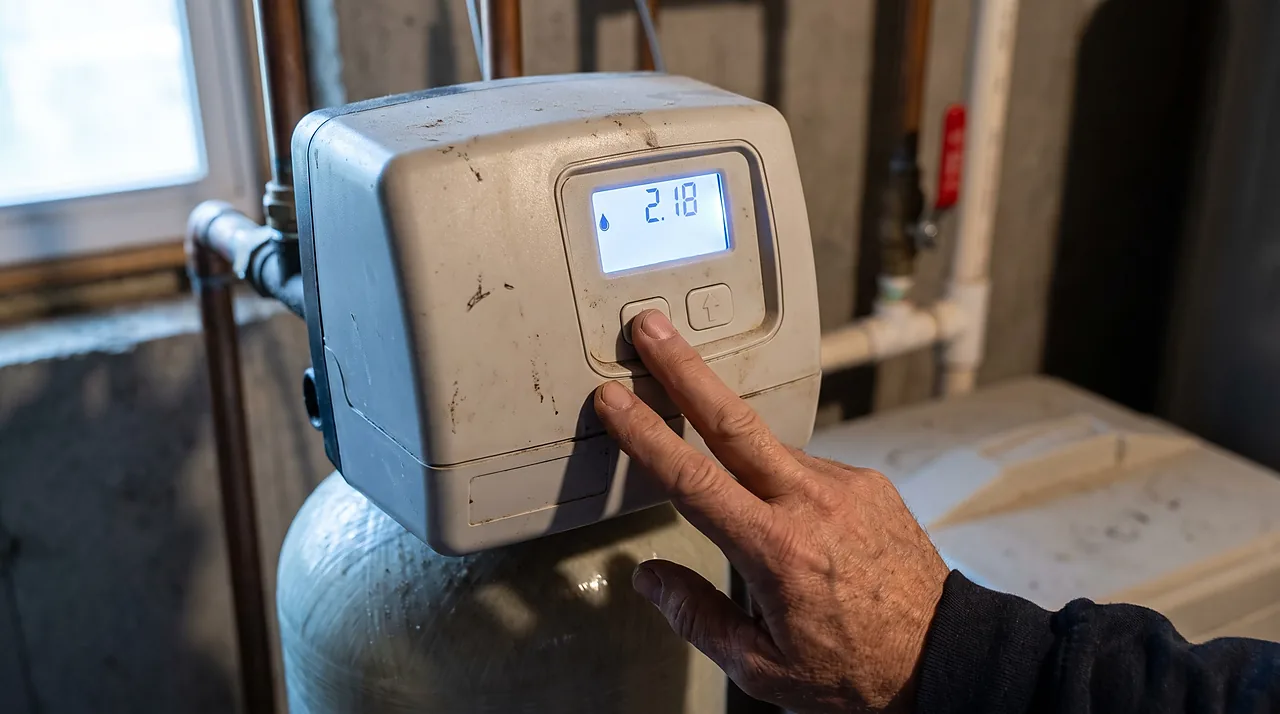
Factory defaults rarely fit. The hardness is often a placeholder like 20 or 25. The capacity is often the big number from the box. The resin, the bed of small plastic beads in the tall tank that traps hardness, reaches that number only with a wasteful dose of salt. You'll find all four settings on the control head, the valve with the display on top of that tank. The labels change by brand, but the decisions stay the same.
For exact button presses on your model, see the Fleck 5600SXT settings walkthrough, the Clack WS1 programming guide or the GE softener settings guide.
Your four settings: what to enter, and how a wrong one shows up
- Hardness
- Your own test result in grains per gallon (gpg), plus 3 to 5 gpg for every 1 ppm of clear-water iron. A grain is a tiny unit of weight, about 65 milligrams. Set too low, it lets hard water slip through in the days before each regeneration. Set too high, it pays for extra regenerations you don't need.
- Capacity and salt dose
- The grains your resin removes at the salt dose you chose: about 20,000 per cubic foot of resin at 6 pounds of salt per cubic foot, for example. Set higher than that, your soft water runs out a day or two before the softener regenerates.
- Regeneration trigger
- Metered, also called demand-initiated, so the softener runs its cleaning cycle, called regeneration, only after you've used a set number of gallons. A plain timer regenerates on a fixed day, whether the house used 200 gallons that week or 2,000.
- Time of day
- The current time, with the right AM or PM, and a regeneration start when nobody uses water, 2 a.m. by default. A wrong clock moves the cycle into the middle of your day.
Some cabinet softeners word these differently. They may ask for the number of people in the home, or offer a salt-efficiency mode in place of a capacity number. Behind the screen they make the same four decisions.
Hardness: the number from your own water test

The hardness setting tells the valve how many grains of calcium and magnesium arrive in every gallon. The valve divides its capacity by that number to work out how many gallons it can soften before the next regeneration. Get the hardness wrong and every cycle after it is wrong too.
Use a test of the water coming into the house, taken from a tap the softener doesn't feed, often an outdoor spigot. If your water report lists hardness in mg/L or ppm, divide by 17.1 to get gpg and round up. A city report gives an average for the whole system, so treat it as a stand-in until you've tested your own tap. The hardness testing guide compares strips, drop kits and lab tests.
So is 25 a good setting? Only if your water tests at 25 gpg. Valves ship with a placeholder; the Clack WS1, for example, defaults to 20 and accepts anything from 1 to 150. A setting of 25, 30 or 50 is right for exactly one water, the one that tests that hard. All three sit far above 10.5 gpg, where the Water Quality Association's scale starts calling water very hard. If a report says 50, check the unit first: 50 mg/L is only about 3 gpg.
Lowering the number won't leave a little hardness in your water. The softener still delivers fully soft water but runs out early, so the last day or two of each cycle comes through hard. If you'd like some hardness left in, that takes a blending valve, which mixes a little hard water back in. Some valves have one built in; others need it added.
On a well, test for iron too. Add 3 to 5 gpg to the hardness setting for every 1 ppm of clear-water iron. That's the iron that pours out clear and leaves orange stains later. A softener copes with that iron only up to about 1 to 3 ppm, depending on the unit.
Above that, or if the water already runs red, you need a dedicated iron filter. Manganese counts too; your valve's manual gives the amount to add for it. The hardness setting guide covers the iron math in detail, and softeners on well water covers the rest.
Capacity and salt dose: how much work one regeneration buys

Capacity is how many grains of hardness the resin can hold before it has to regenerate. It depends on the salt dose, the pounds of salt the softener dissolves into brine for each regeneration. More salt buys more capacity, but each extra pound buys less.
The number on the box hides this. A "32,000-grain" softener holds 1 cubic foot of resin. It reaches about 30,000 to 32,000 grains only at about 15 pounds of salt per regeneration. At 6 pounds it removes about 20,000. Type 32,000 into a valve set for the lighter dose, and the meter keeps counting gallons after the resin is spent.
You feel it at the end of the week. The shower goes from slippery to squeaky on Thursday, yet the softener doesn't regenerate until Saturday.
Match the capacity to the salt dose you actually set:
| Resin (box rating) | Efficient: 3 lb salt per cu ft | Balanced: 6 lb salt per cu ft |
|---|---|---|
| 0.75 cu ft ("24,000") | 9,000 grains, 2.25 lb salt | 15,000 grains, 4.5 lb salt |
| 1 cu ft ("32,000") | 12,000 grains, 3 lb salt | 20,000 grains, 6 lb salt |
| 1.5 cu ft ("48,000") | 18,000 grains, 4.5 lb salt | 30,000 grains, 9 lb salt |
| 2 cu ft ("64,000") | 24,000 grains, 6 lb salt | 40,000 grains, 12 lb salt |
The efficient column gets about 4,000 grains out of each pound of salt, the figure the Water Quality Association asks installers to set. It regenerates more often, so it suits a softener with room to spare. The balanced column gets about 3,300 grains per pound and stretches the time between regenerations. That helps a softener that's on the small side for the house. Pick the dose that gets you a regeneration about once a week; the grain capacity guide explains the trade in more depth.
Some valves ask for pounds of salt directly. Others set the dose as a brine refill time in minutes, and the manual tells you how many pounds each minute adds.
The salt level in the brine tank, the shorter tank you pour the bags into, is a different thing and not a setting. Keep that tank a quarter to half full, with salt sitting above the water, and check it once a month. How much salt a softener uses covers bag counts and refills.
Regeneration trigger: counted gallons or a fixed day
Each regeneration rinses brine through the resin to wash out the hardness it collected, and something has to tell the softener when to start. There are two choices.
- Metered, or demand-initiated. A small turbine in the valve counts the gallons you use, and the softener regenerates once the capacity is nearly used up. It saves salt and water, and the Water Quality Association advises against using time clocks to start regeneration. Choose metered whenever your valve offers it.
- Timer, or calendar. The softener regenerates every set number of days, used or not. If that's all your valve can do, work out the days yourself: capacity divided by (people x 75 gallons x hardness), rounded down.
Metered valves add two backup settings. The reserve holds back part of the capacity, because the softener waits for its 2 a.m. start even after the count runs low. Without it, tonight's showers would run hard. Some valves size the reserve on their own. If yours asks, about one day's water use covers the gap. The U.S. Geological Survey puts indoor use at about 80 to 100 gallons per person a day, and sizing guides use 75.
The day override forces a regeneration after a set number of days, even if the meter hasn't called for one. Set it a little longer than your normal cycle so it acts only as a backup, for example while you're away. Vacation mode explains what else to change for a trip. The full comparison of the two triggers is in demand vs. timer regeneration, and how often a softener should regenerate shows what a healthy cycle looks like.
Time of day: the 2 a.m. start and the AM/PM trap

The clock decides when regeneration starts, and most valves default to 2 a.m. The cycle takes roughly 85 to 110 minutes and sends about 35 to 65 gallons down the drain. During it, most single-tank softeners send untreated hard water to the house, which nobody notices at 2 a.m.
Flip AM and PM, and that regeneration runs at 2 p.m. instead. You hear the softener gurgling in the middle of the afternoon. For the next hour and a half, the water at the kitchen sink feels hard again. Set the current time with the right AM or PM. Move the start time only if someone in the house uses water at 2 a.m., such as a dishwasher on a night timer.
Power cuts are the usual reason a clock goes wrong. The Fleck SXT owner's manual says that valve keeps time for at least 48 hours without power. Digital valves generally keep the rest of their settings. After a longer outage, check the clock first, then the list in what to check after a power outage. If you need to shut the softener off while you sort it out, the bypass valve routes water around it.
Settings for a family of four, worked through
Take four people on city water that tests at 12 gpg, with a 1.5-cubic-foot softener sold as "48,000 grains".
- Hardness: 12. City water carries no iron to speak of, so the test result goes straight in.
- Daily load. 4 people x 75 gallons x 12 gpg = 3,600 grains of hardness a day, or about 25,200 a week.
- Capacity: 30,000 grains at 9 pounds of salt. That's the balanced dose of 6 pounds per cubic foot, and it covers a week. The efficient dose (18,000 grains) would trigger a regeneration every four days or so.
- Gallons between regenerations. 30,000 / 12 = 2,500 gallons. Hold back one day's use (300 gallons) as the reserve, and the valve regenerates after about 2,200 gallons, roughly every seven days. If your valve asks for the reserve as a percentage, 300 of 2,500 is about 12%.
- Salt. About four regenerations a month at 9 pounds each comes to roughly 36 pounds, a little under one 40-pound bag.
Put the same house on a well with 1 ppm of clear-water iron, and the hardness setting rises to 15 to 17 gpg. Nothing else changes, and the softener now regenerates about every five to six days.
Work out your settings
Every guide in Settings and programming
Questions people ask
Should I set the hardness a little higher than my test, just to be safe?
A point or two above your test does little harm and covers small swings in your water. A bigger margin only shortens every cycle and burns salt. If you're getting hard water, check the capacity setting and the salt in the brine tank before you raise the hardness.
Is 30 gpg hard water?
Yes, very hard. The Water Quality Association's scale starts "very hard" at 10.5 gpg. In mg/L, 30 gpg is about 513, far past the 180 mg/L where the U.S. Geological Survey starts calling water very hard. A family of four on 30 gpg water puts roughly 9,000 grains of hardness into the resin every day, so it's worth checking that the softener is big enough for that load.
Do I need to change the settings when someone moves in or out?
On a metered softener, the meter counts the extra or missing gallons for you. Update the reserve to one day's use for the new household, or the number of people if your softener asks for it. On a timer softener, recalculate the days between regenerations. The hardness setting changes only when your water does, for example after a new well or a change in your city's supply.
My softener regenerates almost every night. Which setting is wrong?
Look at three things. A capacity set far too low and a hardness set far above your test both shorten the cycle. If both look right, turn off every tap and watch the flow indicator on the display: if it still moves, a running toilet or a small leak is spinning the meter around the clock.
Can a wrong setting damage the resin?
No. A wrong number costs you salt and water, or lets hard water through at the end of each cycle, but the resin itself isn't harmed. Correct the setting and the next cycle runs right.
Sources
- U.S. Geological Survey - "Hardness of Water"
- U.S. Geological Survey - "Water Q&A: How much water do I use at home each day?"
- Water Quality Association - "Getting Smart With Softeners"
- Pentair (Fleck) - "Fleck SXT Owner's Manual"
- Clack Corporation - "WS1 & WS1.25 Control Valve Series Programming Manual"


