On this page
- Is the noise coming from the softener at all?
- What a normal regeneration sounds like
- Match the sound to the cause
- Humming, grinding, or clicking from the control head
- Water running or hissing that won't stop
- Banging or rumbling in the pipes
- Gurgling and sputtering faucets: air in the tank
- Whirlpool and other all-in-one units
- Fix it, or is the softener done?
Most softener noise is the softener cleaning itself. That cycle, called regeneration, usually starts around 2 a.m. and runs about 85 to 110 minutes. It sounds like a short motor hum, then water rushing to the drain.
Noise at any other time is the clue. A hum that won't quit, water still running at breakfast, or a bang in the pipes each points to a different part. Most of them lead to an inexpensive fix.
Is the noise coming from the softener at all?
Start by finding the source. How you check depends on the kind of sound.
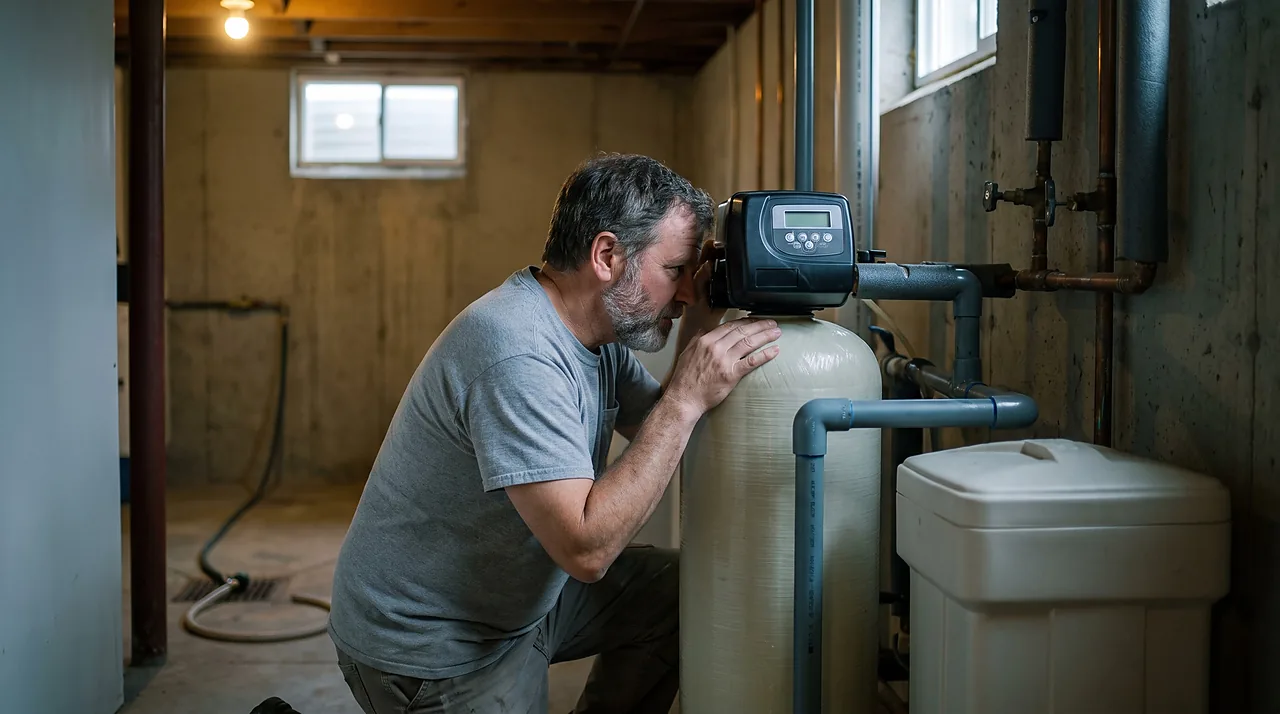
- A hum, grind, or click. Rest a hand on the control head, the valve assembly on top of the tall resin tank. If you can feel the sound there, it's the softener's motor or gears. Unplug the softener for a moment if you're unsure, and listen for the sound to stop.
- Rushing, hissing, or knocking water. Turn the bypass valve to Bypass. It sits where your house pipes connect to the control head. Depending on the model, it's two quarter-turn handles, a single lever, or a push-pull plunger. In Bypass, water flows around the softener, so the house still has water but none passes through the softener.
If a water sound stops in Bypass, the softener is the source. If it carries on, look at the rest of the house: a running toilet, a dripping outdoor faucet, a pressure-reducing valve, or pipes hammering.
Water pouring into the drain hour after hour is the one sound that costs money for as long as it runs. If that's what you hear, leave the bypass valve in Bypass while you work out why.
What a normal regeneration sounds like
While it's softening your water, a working softener makes almost no sound at all. You hear it during regeneration, and a softener sized for the household is usually set up to regenerate about once a week.
The cycle moves through stages, and each one has its own sound:
- A short hum and a click as the control head shifts to the next stage. The motor runs only for the move, then stops.
- Rushing water at the drain during backwash, when water flows up through the resin (the beads that do the softening) to flush out dirt.
- A quiet hiss and a long trickle while the softener draws salty water, called brine, out of the brine tank and rinses slowly. This stage is usually the longest.
- A brief slurp from the brine tank when the brine runs out. On many softeners that's the air check closing. It's a small float valve at the bottom of the brine well, the tube inside the brine tank.
- A second rush of water for the fast rinse, then a gentle trickle into the brine tank as it refills for next time.
If that cycle wakes you, move the start time. Pick an hour when nobody runs water, because the house gets hard water while the softener regenerates. The Fleck 5600SXT settings guide shows where that setting lives on one common control head.
Match the sound to the cause
Tap the sound you're hearing to jump to what it means.
- A hum, then rushing water, around 2 a.m., finished within about two hours
- Normal regeneration. A short slurp from the brine tank partway through is normal too.
- A hum, groan, or grinding from the control head that goes on and on
- The drive motor straining against a stuck piston, or worn gears.
- Clicking or snapping that keeps repeating
- Gear teeth slipping, or a faulty switch making the control head cycle over and over.
- Water running or hissing at the drain for hours
- A control head stuck partway through its cycle. It wastes water until you stop it.
- A hiss only while someone uses water
- A bypass valve left halfway between positions.
- A bang when a faucet or appliance shuts off, or during regeneration
- Water hammer. It usually starts in the house pipes, but the softener can set it off.
- Pipes that rumble or vibrate
- House water pressure that's too high.
- Long gurgling, plus faucets that sputter
- Air trapped in the resin tank after a repair, an install, or a water shutoff.
- A rattle or clunk when water runs
- Something loose: a brine tank lid, a tank that isn't sitting level, or a pipe bracket. Tighten or reseat it.
Humming, grinding, or clicking from the control head

Inside the control head, a small electric motor drives a piston from stage to stage. The piston is the part that slides inside the control head to open and close each water path. On a Fleck 5600SXT, for example, it's a 24-volt motor that turns at just 2 rpm. A short, low hum at each stage change is normal.
Older softeners with a dial clock are the exception. Their clock runs on a small timer motor that turns all day, so a faint, steady hum can be normal there.
A hum that drags on during regeneration, a groan, or grinding means the motor is fighting something. Usually the piston is binding in its seals, because iron, sediment, or swollen rubber makes it stick. The motor keeps pushing, and the plastic gears take the strain until teeth chip or strip.
Loud clicking or snapping is often those damaged teeth skipping. Clicking can also come with the control head cycling again and again. Fleck's service manual lists a misadjusted, broken, or shorted switch as the cause of that.
Many electronic control heads eventually stop and show an error. Fleck's manual, for instance, flags a drive that takes longer than 6 minutes to reach the next stage. Its advice is to check the motor and drive train. To look for yourself:
- Put the softener in Bypass, unplug it, and take off the cover. Check the gears for chipped, cracked, or missing teeth.
- Turn the bypass valve back to Service, so the control head is working under normal water pressure, and plug the softener back in.
- Start a manual regeneration and watch the gears. Teeth that slip point to a broken gear or a stuck piston. A motor that hums but never turns is either dead or held by a jammed piston.
To tell a dead motor from a jammed piston, use the test in testing and replacing a water softener drive motor. A piston that binds needs new seals and spacers, which is the valve rebuild job. If your display already shows a code, start with Fleck 5600SXT error codes or your own owner's manual.
Water running or hissing that won't stop

It's 9 a.m., everyone has left for the day, and you can still hear water hissing into the drain. A normal cycle would have finished hours ago.
The control head has stopped partway through its cycle, with the path to the drain still open. In Fleck's troubleshooting table, the cause listed for a drain that flows continuously is a valve that isn't programming correctly. A failing motor or a binding piston can leave it stuck the same way.
Unplugging won't stop this sound. The open drain path doesn't need power, so house pressure keeps pushing water through it. Pulling the plug in the middle of a cycle can even cause it, because the control head stays parked wherever it stopped. Turn the bypass valve to Bypass to stop the flow, then follow softener stuck in regeneration.
A different hiss shows up only while someone is using water. That's often the bypass valve left partway between Service and Bypass, so water squeezes through a narrow gap. Push or turn the handles all the way to their stop.
Banging or rumbling in the pipes

The washing machine finishes filling, and a bang shakes the wall behind it. That's water hammer. The American Society of Plumbing Engineers explains why it happens. When a valve closes fast, the moving water stops all at once and sends a pressure shock back through the pipes.
The softener can set it off too, when the control head shifts during regeneration. A thump that comes only during the night cycle points there. Certified softeners are tested for this kind of strain: NSF/ANSI 44 includes 100,000 pressure cycles from 0 to 150 psi. Pipe joints and plastic fittings are the parts that suffer over time.
Two steps cover most cases:
- Add a water hammer arrestor, a small sealed cylinder with a cushion of air inside, close to the valve that slams shut. The washing machine hookup is the usual spot, or the pipes near the softener if the bang comes during regeneration. Strap any loose pipe that knocks against the framing.
- Check the house pressure. Screw a pressure gauge onto an outdoor faucet or laundry tap and read it with every tap in the house closed. Most plumbing codes call for a pressure-reducing valve when that reading tops 80 psi. High pressure also makes pipes rumble and hammer harder.
Gurgling and sputtering faucets: air in the tank
After a repair, a new install, or a shutoff of the water main, air can get trapped in the resin tank. The softener gurgles for a long stretch, and faucets spit and cough afterward.
Run cold water at a bathtub faucet until it flows smoothly. If the gurgling continues, a manual regeneration pushes the rest of the air out through the drain.
A brief slurp when the brine runs out is normal. Long gurgling at every regeneration, with sputtering faucets afterward, is different. It can mean air is getting into the brine line, the tube between the two tanks, at a loose fitting.
Whirlpool and other all-in-one units
Cabinet softeners, where the salt and the resin tank share one housing, use a different control head from the Fleck examples here. The sounds still mean the same things. A hum and rushing water at night are normal, while grinding, nonstop drain flow, or banging point to the same causes. For display codes, use your owner's manual, or see cabinet water softener problems.
Fix it, or is the softener done?
Almost every noise on this list leads to an inexpensive part: a motor, a gear, a seal kit, or an arrestor. For comparison, a new softener with professional installation typically costs about $1,000 to $3,000. Prices vary by region, so check current quotes.
The math changes on an old unit. Say a softener that's 10 to 15 years old grinds, leaks, and lets hard water through. Its resin may be near the end of its life as well. In that case, weigh your options in repair or replace, and check for the signs of a softener that's not softening.
Questions people ask
Should I hear my water softener every night?
Usually not, since most softeners are sized to regenerate about once a week. Nightly cycles can mean the settings are too aggressive or the softener is too small. They can also mean water is being used when nobody notices, such as a running toilet.
Why is my softener running at 2 p.m. instead of 2 a.m.?
Its clock is wrong, most often after a power outage. Reset the time of day on the control head, and the cycle moves back to the night.
Why is my softener louder than it used to be?
A cycle that slowly gets louder often means the piston is starting to bind, so the motor works harder at each stage change. High house pressure makes the water sounds louder too. So does a drain hose that isn't fastened down and slaps as the water rushes through.
What are the signs a water softener is failing?
Spots and scale coming back, soap that won't lather, and a salt level that stops dropping are the usual ones. A new grinding sound or water that runs to the drain all day are the noisy signs.
How long does a water softener last?
The resin typically lasts about 10 to 15 years on chlorinated city water and longer on clean well water. That's usually when replacing the whole unit makes sense. Motors, gears, and seals wear out sooner, but they're replaceable, so a noise alone rarely means the softener is finished.
Read next


Sources
- Pentair / Fleck
- American Society of Plumbing Engineers (ASPE)
- Water Conditioning & Purification (WC&P) International