On this page
- Five checks before you take anything apart
- Match the symptom to the cause
- Hard water and the salt isn't going down
- Hard water while the salt keeps going down
- Water standing high in the salt storage area
- An error code, a blank display, or stuck in recharge
- Recharging every two or three nights
- Pressure dropping over the years, or beads in the water
- Leaks you can't see in a closet
- Repair it or replace it?
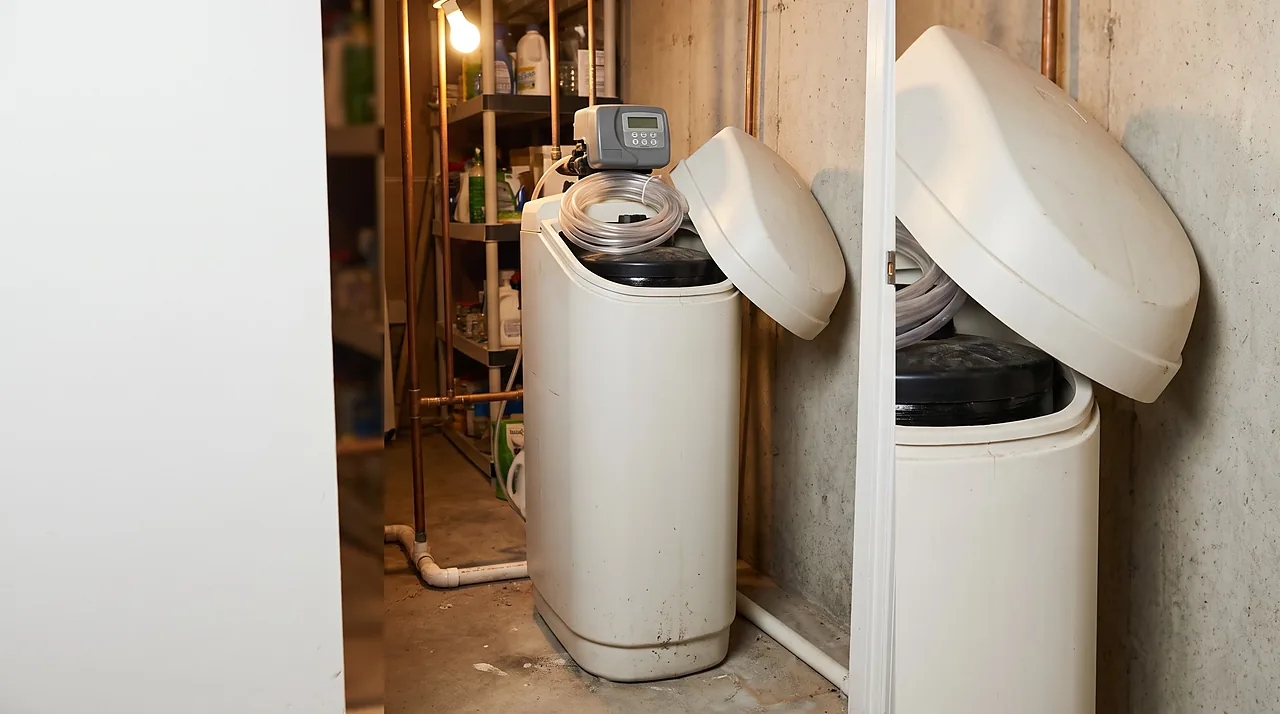
Cabinet softeners aren't junk. The resin inside softens water the same way a two-tank system's does, and both designs are held to the same NSF/ANSI 44 standard. What sets cabinets apart is where things sit. The resin tank, the tall cylinder of beads that does the softening, stands inside the salt storage area, all in one housing.
That layout creates three predictable weak points:
- The electronics live in salty, damp air. The motor, the position switch, and the control board sit under a top cover just above the salt.
- The resin tank is small and hard to reach. It recharges often, and replacing its resin is a bigger job.
- The cabinet is one piece. The salt sits in a tight space around the resin tank, and a crack in the cabinet means replacing the whole salt storage area.
The warranty tells the same story. Whirlpool's WHES30 manual covers the salt storage tank and the resin tank for 10 years. It covers the electronic control board for three years, and all parts for one. The manufacturer backs the tanks far longer than the parts that move or switch.
Five checks before you take anything apart
These take a few minutes and solve a surprising share of "broken" softeners. You'll lift two things: the salt lid, where you pour in salt, and the top cover over the valve.
- Is there a display? A blank display usually means no power. Check the outlet and the plug-in power supply before anything else.
- Is the bypass valve in Service? The bypass valve is where the house pipes connect, usually at the back of the cabinet. If it was bumped into Bypass, hard water flows straight past the softener.
- Is there salt above the water? Lift the salt lid. Keep the salt storage area a quarter to half full, always above the water line, and check it once a month.
- Is the clock right? The cleaning cycle, called recharge or regeneration, is timed for the night. After a power outage, a wrong clock can move it into the day, and hard water reaches the taps while it runs.
- Is the water actually hard? Test cold water with a hardness test strip. Hardness is measured in grains per gallon (gpg), and spots on glasses can come from other causes, so measure first.
If the checks don't explain it, find the model number on its label and keep the owner's manual handy. Its troubleshooting chart is the authority for your exact unit.
Match the symptom to the cause
Tap what you're seeing to jump to the fix.
- Hard water, and the salt level hasn't dropped in weeks
- No brine is reaching the resin: a salt bridge, salt mush, or a clogged nozzle and venturi. Usually a free DIY fix.
- Hard water, even though the salt keeps going down
- A setting that doesn't match your water, a bypass valve partly open, or tired resin. Usually a setting change.
- Water standing high in the salt storage area
- Brine isn't being pulled out during recharge, or the drain hose is blocked. Usually DIY.
- An error code, a blank display, or stuck in recharge
- The motor, switch, or board under the top cover. A reset is free; a board is the borderline repair.
- Recharging every two or three nights
- Often the resin tank is small for your household's load. A math check, then a setting change.
- Water pressure dropping over the years, or beads in the water
- Resin breaking down, or a broken part inside the resin tank. Real work in a cabinet, and often the turning point toward replacement.
- A wet floor, a musty closet, or a cracked cabinet
- A slow leak, an overflow, or a split cabinet. A crack means a new salt storage tank, or a new softener.
Hard water and the salt isn't going down

The bag of salt you poured in October is still sitting there in December, and the glasses are coming out spotted. The softener can only recharge its resin with brine, the salty water it draws out of the salt storage area. If the salt level sits still for weeks, brine isn't reaching the resin. There are three usual reasons.
- A salt bridge. A hard crust forms across the salt, with an empty space under it, so the salt never touches the water. Push a broom handle gently down through the salt. If it stops on a solid layer, break the crust carefully and scoop out the chunks, as the salt bridge guide shows. In a cabinet the salt sits in a tight space around the resin tank, so work gently and never pound on the cabinet walls.
- Salt mush. Dissolved salt can settle back into a thick sludge at the bottom, where it blocks the brine intake. Scoop it out, rinse the area, and refill with fresh salt. The salt mush guide covers it step by step.
- A clogged nozzle and venturi. This small assembly creates the suction that pulls brine into the resin tank. The Whirlpool WHES30 manual warns that if it plugs with sand, silt, or dirt, the softener won't work and hard water results.
On many cabinet units the nozzle and venturi sits on the valve, under the top cover. Follow your manual to take it apart, rinse the screen and parts in warm water, and reassemble. The injector cleaning guide shows the same job on other valves. Once the brine path is clear, start a manual recharge so the resin gets a full dose right away.
Hard water while the salt keeps going down
Salt that disappears on schedule means the softener is recharging. If the water is still hard, the problem is what happens between recharges:
- The hardness setting is wrong. Many units are set to a city average or a guess. Test your untreated water and enter that number, as the hardness setting guide explains. GE owners can find the steps in GE water softener settings.
- Iron wasn't added in. The WHES30 manual says to add 5 to the hardness number for each 1 ppm (part per million) of iron. That applies to clear-water iron, the kind that's dissolved and invisible until it hits air. General guidance runs 3 to 5, and softeners handle only about 1 to 3 ppm of it. Red, rusty water needs an iron filter.
- The bypass valve is partly open. Raw water slips past the resin. Push or turn the handles all the way to Service.
- The resin is tired. If the water is soft right after a recharge but goes hard days before the next one, see hardness creeping back.
Water standing high in the salt storage area
Some water in the salt storage area is normal, because that's where brine forms. What matters is that the salt sits above it. Water that rises over the salt, or keeps climbing, means the softener isn't pulling the brine out during recharge.
A clogged nozzle and venturi is the first suspect, so start by cleaning it. Then check the drain hose for kinks, and for a clog where it reaches the floor drain or standpipe (the open pipe it empties into). A leak inside the valve can cause it too. The brine tank full of water guide walks through the rest, including the float that should stop the refill.
An error code, a blank display, or stuck in recharge

This is the first weak point in action. The motor, the control board, and the position switch all sit under the top cover. That switch tells the board where the valve is. Salty, damp air reaches their contacts, and corrosion follows.
Start with the reset your brand publishes. EcoWater and Morton cabinet units share one list of codes and steps, explained in EcoWater and Morton error codes. Whirlpool and GE units have their own sequence in the Whirlpool and GE recharge reset guide.
The morning after a storm, a blank display is often a power problem, so check the outlet first. Before you order a board, look for water on top of the valve and green or white crust on the connectors. A new board in a damp, salty enclosure can fail the same way.
Recharging every two or three nights
Owners often read frequent recharges as a broken meter, the part that counts the water you use. More often the resin tank is small, and you can check that yourself with the numbers from your manual.
Take the Whirlpool WHES30, sold as a 30,000-grain model. Its manual lists 0.82 cubic feet of resin and three rated capacities, one for each salt dose (the pounds of salt used per recharge):
- 2.9 lb of salt
- 12,800 grains, about 4,400 grains per pound of salt. That meets the Water Quality Association's best-practice target of at least 4,000 grains per pound.
- 8.0 lb of salt
- 24,600 grains, about 3,100 grains per pound.
- 13.1 lb of salt
- 28,900 grains, about 2,200 grains per pound. The 30,000 on the box is close to this most wasteful dose.
Now work out your own load. Multiply the people in the house by 75 gallons a day, the Water Quality Association's design figure, and then by your hardness in gpg. Four people on 10 gpg use 300 gallons and load the softener with about 3,000 grains a day.
Divide the capacity by that daily load. At the 2.9 lb dose, 12,800 grains lasts that family about four days, and at 8.0 lb about eight. On 20 gpg the same family loads 6,000 grains a day, so 12,800 grains lasts about two days.
Most softeners also hold a little capacity in reserve, so they recharge slightly sooner than the math says. A recharge every two or three nights on hard water is the small tank doing what its rating says. A softener sized for the house usually recharges about once a week, and the sizing guide shows what size fits yours.
Pressure dropping over the years, or beads in the water
Resin breaks down with age. Chlorine in city water shortens its life, and worn beads can pack together and choke the flow. If the pressure comes back when you switch the bypass valve to Bypass, the softener is the cause. The low pressure after a softener guide helps you narrow it down.
Tan or amber beads in a faucet screen are a different problem. They usually mean a cracked part inside the resin tank: the distributor tube down its middle, or the screen at its bottom.
Either way, this is the second weak point. On a two-tank softener the resin tank stands in the open. In a cabinet it sits inside the salt storage area, so new resin means disconnecting the plumbing and lifting a heavy, wet tank out. It's possible, as replacing water softener resin explains, but on an older unit it's often the job that tips the decision toward replacement.
Leaks you can't see in a closet

Cabinet softeners often live in tight laundry closets, where a slow drip can soak the subfloor for months. The Water Quality Association says to watch for musty odors, dampness, or mold under appliances, since leaks there can stay hidden. If the closet smells damp, or the baseboard feels soft when you press it, it's time to look underneath.
Put the bypass valve in Bypass and unplug the softener first. A full cabinet is heavy with water and salt, and the supply connections limit how far it can move, so slide it out slowly. Then check three things:
- The overflow fitting on the side of the cabinet. If it has a tube, the tube should run to a floor drain. An overflow with nothing attached puts brine on the floor the first time the salt storage area overfills.
- Cracks in the cabinet itself. This is the third weak point. The cabinet is the salt storage area, which the manual calls the salt storage tank, so a crack means replacing it. If yours is a Whirlpool, that tank carries a 10-year warranty against leaks. For other brands, check your manual before you buy anything.
- How it's leveled. The WHES30 manual warns never to put shims directly under the salt storage tank. Full of water and salt, it's heavy enough to crack at the shim.
For drips from the valve or the fittings, the water softener leaking guide maps each spot to its fix.
Repair it or replace it?
Here's how the common faults sort out:
- Usually DIY, little or no cost: salt bridges and mush, a clogged nozzle and venturi, a blocked drain hose, and wrong settings.
- Inexpensive parts: a position switch or a motor.
- Borderline: a control board, or new resin in a cabinet.
- Usually replace: a cracked cabinet out of warranty, or an old unit with several of these at once.
Resin typically lasts about 10 to 15 years on chlorinated city water. A cabinet softener near that age with a failed board and tired resin is usually better replaced.
Homewyse's national estimate for replacing a softener starts at roughly $1,063 to $1,387 for the unit and basic labor. Larger systems with professional installation can run up to about $3,000. Check current quotes, and compare them in repair or replace. If a small footprint is what your space needs, the compact water softener guide compares the options.
Read next


Questions people ask
Why does salt keep bridging in my cabinet softener?
The salt sits in a tight space around the resin tank, and humid air helps it cake. Overfilling makes it worse. Keep the salt a quarter to half full instead of topping it up to the rim, and check it monthly with a broom handle.
How often should a cabinet softener recharge?
A softener sized for the household usually recharges about once a week. Much more often points to a small resin tank or a hardness setting that's too high. It can also mean water is being used when nobody notices, such as a running toilet.
How long does a cabinet water softener last?
The tanks usually outlast everything else. The resin typically gives about 10 to 15 years on chlorinated city water and more on clean well water. The motor, switch, and board are the parts most likely to need replacing along the way.
Can I solder new copper pipe right at the softener's bypass valve?
Not with the valve attached. The Whirlpool WHES30 manual warns that soldering heat will damage the plastic bypass valve. Solder the fittings first, let them cool, then connect the valve.
Sources
- Whirlpool WHES30/WHES33 Installation and Operation Manual (Ecodyne Water Systems)
- Water Quality Association, "Getting Smart with Softeners"
- Water Quality Association, "Residential Water Treatment Design"
- Homewyse, "Cost to Replace a Water Softener"