On this page
- First: stop the water and make sure it's really stuck
- Step it out of the cycle with the regeneration button
- What the valve does tells you which part failed
- The timer motor: when nothing moves at all
- The piston: when something's jamming it mid-stroke
- The switch: when the valve loses track of where it is
- Repair it or replace the valve?
Turn the bypass valve to Bypass. That cuts the softener off from house pressure, so the water running to the drain stops, while every tap in the house keeps working.
Then try to step the valve out of regeneration, the softener's cleaning cycle, with its regeneration button. How it responds tells you which of three parts failed: the motor that drives the valve, the piston and seals inside it, or the switch that tells it where it is.
First: stop the water and make sure it's really stuck
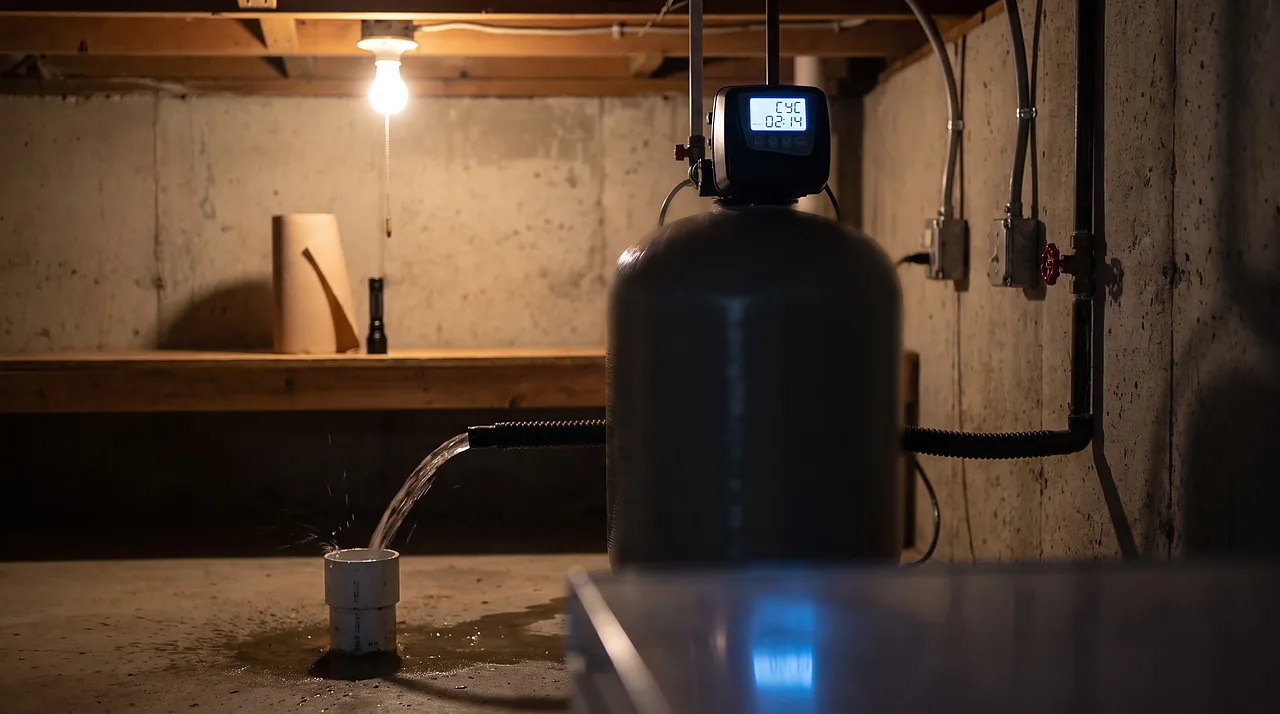
It's 7 a.m., the softener should have finished hours ago, and you can still hear water hissing into the drain behind the furnace. Here's what to do, in order:
- Turn the bypass valve to Bypass. It sits where the house pipes join the control head, the valve assembly on top of the tall resin tank. It may be two handles, a single lever or a push-pull plunger (bypass valve positions). A normal cycle already sends roughly 35 to 65 gallons to the drain, so a valve stuck open can waste hundreds of gallons by morning. On a well, the pump runs the whole time too.
- Check how long it has been running. Most regenerations start around 2 a.m. and finish in about 85 to 110 minutes. Clack's manual lists 57 to 107 minutes for its standard softener settings. Water still running well past two hours, or past the total time your manual lists, means something is wrong.
- Note what the display shows, such as a stage name, a countdown that has stopped, or an error message. You'll need it in a minute.
Make sure the water is coming from the right hose. The drain hose runs from the control head. The brine tank is the shorter tank that holds the salt. If water trickles from the overflow tube on its side, that tank is overfilling, which is a different fault (brine tank full of water).
Step it out of the cycle with the regeneration button

Most digital valves let you skip ahead one stage at a time. The trick is a short press. Holding the button usually starts a fresh regeneration, which is the opposite of what you want.
- Fleck SXT valves (5600SXT and its relatives). Pentair's manual says that during regeneration, pressing the Extra Cycle button forces the control to move to the next stage right away. Tap it once, wait for the motor to stop, then tap again until the display returns to the time of day. Holding it for five seconds starts a new regeneration.
- Clack WS1 valves. Clack's manual says pressing REGEN steps the valve through the stages. Tap and wait each time. Holding REGEN for about three seconds starts a regeneration you can't cancel. The only way out is a reset: press NEXT and REGEN together for three seconds.
- Older mechanical timers. These usually have a knob or dial you turn by hand through the cycle positions. Your manual shows which way it turns.
- Cabinet units (Whirlpool, GE, Kenmore, Morton) and Culligan. The buttons and sequences differ by model, so your manual is the authority. Bypass and unplug works on every one of them while you look it up. The guides to Whirlpool and GE recharge problems and Culligan error codes cover those families.
- Non-electric twin-tank units. These run on water flow and have no button at all, so follow the maker's instructions (twin-tank softeners).
Once the display shows the time of day again, turn the bypass back to Service and watch the drain hose for a few minutes. If it stays quiet, the valve made it home. If it stalled during brine draw, run a cold tap for a few minutes to clear any brine you skipped past. Later in the day, run one full manual regeneration and make sure it finishes on its own (how to start a manual regeneration). Fleck's manual names that same step as the way to clear its error codes.
While you're at the drain hose, check where it ends. Installation instructions for Fleck 5600 valves call for at least 3 inches of open air between the hose end and the drain opening. That gap keeps dirty drain water from being pulled back into the softener.
What the valve does tells you which part failed
Match what you saw when you pressed the button to one of these, then jump to the part.
- Nothing moves and you hear no motor
- No power reaching the motor, or a dead motor or timer.
- The motor strains or stops partway, maybe with an error on the display
- Grit or scale jamming the piston inside the valve, or a stripped drive gear.
- The display says it's back in service, but water still runs to the drain
- Worn seals letting water slip past the piston into the drain.
- The motor keeps cycling around and never settles
- A faulty switch, so the valve never learns it has reached the end.
Two look-alikes belong elsewhere. A softener that finishes normally but regenerates every night often has a settings or meter problem (softener regenerates too often). One that suddenly regenerates in the middle of the day after a power cut usually just has its clock off (softener after a power outage).
The timer motor: when nothing moves at all

A small electric motor turns the gears that move the valve from stage to stage. If it stops while the valve is open to the drain, the display may count down to zero while water keeps pouring out.
Start with power. Fleck's service manual lists an interrupted power supply and a recent power failure among the causes of a valve that fails to regenerate. Check that the plug-in transformer, the small power adapter at the outlet, is seated and the outlet works. Then unplug it for a minute, plug it back in and try the button again.
If the display is lit but the motor stays silent, or clicks without turning the gears, the motor or the timer has failed. Fleck's manuals call the electronic control that runs the motor the timer, and their fix for a defective one is simply to replace it. The drive motor guide shows how to test and swap one.
The piston: when something's jamming it mid-stroke

Inside the control head, a piston slides through a stack of rubber seals and plastic spacers. As it moves, it opens and closes the paths to the tank and the drain. Fleck's troubleshooting table names three reasons water flows to the drain nonstop: the valve isn't positioning correctly, foreign material is lodged in the valve, or there's an internal leak.
- Something wedged in the valve. Grit, scale or iron flakes catch the piston so the motor stalls partway through a stage. It's a common story on well water, where sediment reaches the softener. Fleck's fix is to remove the power head and clean out the bore the piston slides in. The power head is the motor-and-electronics assembly that lifts off the top of the valve as one unit.
- Worn seals. The piston returns to the service position and the display looks normal, yet water hisses down the drain all day. A torn or worn seal lets pressurized water slip past. The fix is new seals and spacers, or a new piston.
Both repairs start the same way. With the softener in Bypass, release the pressure: on many valves you start a manual regeneration and let it run for a minute, so the trapped water bleeds out the drain hose. Then unplug the softener and take off the power head. Seals, spacers and piston usually come together as a rebuild kit, covered step by step in the valve rebuild guide.
The switch: when the valve loses track of where it is

The control board has to know when the valve reaches each position. On many valves a small switch rides against the notched edge of a cam gear and clicks at each stop. Some valves use a small optical sensor in its place, but the job is the same.
When that signal fails, the motor never gets told to stop. You hear it start, run, pause and start again, around and around, and the valve never settles in Service. For a control that cycles continuously, Fleck's manual blames a misadjusted, broken or shorted switch. Its fix is to work out whether the switch or the timer is at fault and replace it, or replace the whole power head.
Repair it or replace the valve?
A motor, a switch or a rebuild kit is an inexpensive part next to a new softener. The math changes when an old unit needs several of them at once, or the control board itself has failed. On a softener past 10 to 15 years, the resin may be near the end of its life too. Weigh the whole picture in repair or replace.
Once it's fixed, read how often a softener should regenerate. Knowing the normal rhythm keeps a routine night-time cycle from sending you back to the basement.
Questions people ask
Is it okay to use water while the softener regenerates?
Yes, you just won't get soft water. Most single-tank softeners send untreated water to the house during the cycle. Running a lot of hot water then refills the water heater with hard water, which is why the cycle is usually set for the middle of the night.
Why does my softener keep draining even when it's unplugged?
Unplugging only stops the motor. House pressure keeps pushing water out through any path left open to the drain. If the display is frozen mid-stage, the valve is simply parked in a drain position, so check the motor and the piston. If it shows the time of day and still drains, worn seals are letting water slip past. Only the bypass valve, or closing the main water valve, stops the flow.
The softener sounds like water running at odd hours. Is it stuck?
Not always. A demand softener may start a cycle whenever its meter decides it's time, and the brine tank refill at the end makes a quiet trickle. Check which hose is running and for how long. A cycle that ends within the usual time is normal, while water still flowing hours later is not.
My water tastes salty after I forced the softener out of the cycle. Is that normal?
It can happen. If you skipped past the rinse stages, brine was still sitting in the resin tank when it went back into service. Run a cold tap until the taste clears, then let the next full regeneration finish on its own. If salty water keeps coming back, see <a href="/salty-water-after-softener/">salty water after the softener</a>.
Can I leave the softener in bypass until the part arrives?
Yes. The house gets hard water in the meantime, but the softener isn't harmed by sitting in bypass. Leave it unplugged too, so it doesn't try to start a cycle.
My Culligan softener is stuck in regeneration. Is it different?
The idea is the same: bypass it to stop the water, then step it out of the cycle. Culligan's buttons and codes vary by model, so use the manual for yours or the <a href="/culligan-error-codes/">Culligan error code guide</a>. Dealer-installed units may also be under a service plan, so check that before opening the valve.
Read next


Sources
- Pentair (Fleck SXT Controllers Owner's Manual)
- Pentair (Fleck 5600SXT Downflow Service Manual)
- Clack Corporation (Water Specialist WS1 & WS1.25 Control Valve Manual)
- Water Quality Association (WQA), "Getting Smart with Softeners"
- Oceanic Water Systems (Installation Instructions for Water Softeners with Fleck 5600 and 5600SXT)