On this page
- Which salt to buy: every bag on the shelf, compared
- Why purity matters more than the brand
- Evaporated pellets: the default for most homes
- Solar salt crystals: cheaper and nearly as clean
- Rock salt and ice-melt salt: keep them out of the softener
- Block salt and potassium chloride: two special cases
- Buying, storing and switching salt
- What a year of salt costs you
Buy evaporated salt pellets or coarse solar salt crystals. Pellets are the purest and leave the least sludge in the brine tank, the shorter tank that holds the salt. Solar crystals often cost a little less and work fine if you clean that tank on schedule.
Skip rock salt, table salt and ice-cream salt, and only buy block salt if your softener's manual asks for it. Two other bags have a place: pellets with an iron additive for water with a little clear-water iron, and potassium chloride for homes avoiding added sodium.
The aisle doesn't make this easy. You're facing bags labeled pellets, crystals, iron fighter and potassium, next to a cheap pallet of ice melt. Every one of them promises softer water.
Which salt to buy: every bag on the shelf, compared
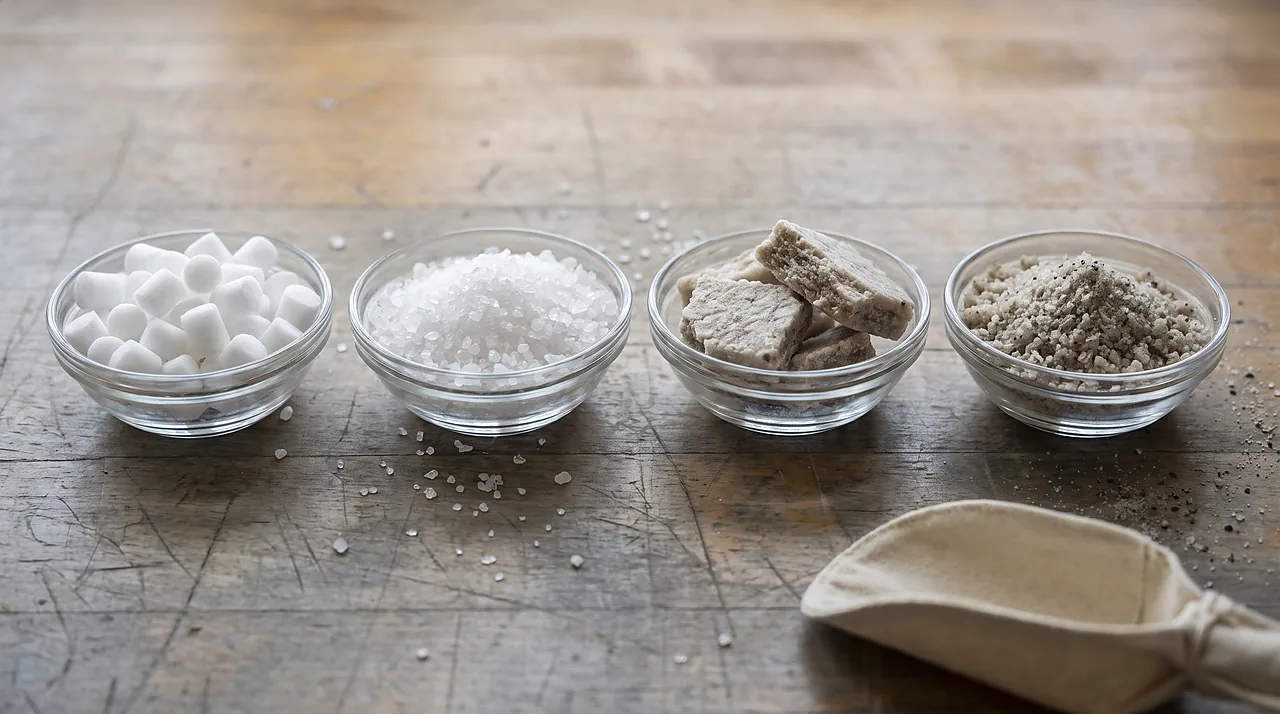
| Salt | What it is | Use it in a home softener? |
|---|---|---|
| Evaporated pellets | Purified brine, evaporated and pressed into pellets | Yes. The default for most homes and the cleanest choice. |
| Solar salt crystals | Brine dried by sun and wind in outdoor ponds, typically above 99.5% pure | Yes. Slightly cheaper, slightly more residue over the years. |
| Pellets with an iron additive | Evaporated pellets plus a resin-cleaning additive | Only if your water carries some clear-water iron. |
| Potassium chloride | A sodium-free substitute that softens the same way | Yes, if you want to avoid added sodium. |
| Block salt | Salt pressed into solid blocks | Only in a softener built for blocks. |
| Rock salt | Mined salt with little refining | No. Its clay and grit end up in the tank. |
| Table, granulated or ice-cream salt | Fine or small-grained salt for kitchens and ice-cream makers | No. Fine grains pack tightly and cake or turn to mush, and softener manuals rule them out. |
To narrow it to one bag, match your house to the first line that fits:
- An all-in-one cabinet softener: pellets. In these units the brine tank is the cabinet itself, wrapped around the resin tank (the tall tank that does the softening). Its floor is awkward to clean, so the purest salt pays off most.
- Well water with a little clear-water iron (water that comes out clear and turns orange after it sits): pellets with an iron additive. Past about 1 to 3 ppm of iron, depending on the unit, a softener can't keep up and the water needs a dedicated iron filter.
- A standard softener with a separate brine tank, on city water: pellets or solar crystals, whichever costs less where you shop.
- A household avoiding added sodium: potassium chloride.
Why purity matters more than the brand
Everything in the bag that isn't salt stays behind. Each regeneration, the softener's cleaning cycle, dissolves salt into the water at the bottom of the brine tank and pulls that brine away. Clay, sand and other insoluble bits can't dissolve, so they settle and pile up. Salt producer Cargill describes exactly this buildup on the floor of the brine tank.
You can run the math for your own house. A typical home uses about 40 to 80 pounds of salt a month, roughly 480 to 960 pounds a year. Every 1% of insoluble material in that salt leaves about 5 to 10 pounds of grit in the tank each year. A bag sold as 99.5% pure has at most half a percent of other material, so at most about 2.5 to 5 pounds a year.
That grit feeds a layer of salt mush at the bottom of the tank. Some of it travels up the brine line, the small tube that carries brine to the control valve on top of the resin tank. There it can lodge in the injector, the tiny nozzle in the valve that draws the brine in.
Humidity causes the other classic problem. Damp, clumping salt can fuse into a salt bridge, a hard crust that hangs over empty space while the water below stays weak. GE Appliances names the wrong salt and high humidity as the most common causes. Push a broom handle down through the salt, and if it stops on a hard crust partway down, that's a bridge.
Evaporated pellets: the default for most homes

Evaporated salt starts as brine that's purified and boiled down, then pressed into uniform pellets. It's the purest salt sold for softeners, so it leaves the least residue. The even shape also lets water move freely around the bottom of the pile.
Pellets are the safe pick when you'd rather not think about salt at all, and they suit every standard softener. Once you've chosen a bag, how much salt your softener uses tells you how often you'll be buying it.
Solar salt crystals: cheaper and nearly as clean
Solar salt is made by letting seawater or natural brine evaporate in outdoor ponds. Cargill puts its purity typically above 99.5% sodium chloride, which meets what softener manuals ask for. It often sells at the cheaper end of the shelf.
The trade-off is that last fraction of a percent. Over a few years it shows up as a thin layer of sand and silt at the bottom of the tank. Cleaning the brine tank every two to three years takes care of it. While the tank is empty, check the brine tank float, the shut-off that sits in a tube inside the tank. Grit around it can make it stick.
Pellets and crystals both make the same strong brine. In a dry room, with the tank kept a quarter to half full, both behave well. Price is a perfectly good reason to choose one.
Rock salt and ice-melt salt: keep them out of the softener

Rock salt is mined and lightly processed, so it still carries the clay and rock it came out of the ground with. Many ice-melt products are rock salt, some blended with other chemicals, and none of that belongs in a brine tank.
On an icy driveway the grit helps your tires. In a softener it settles into a heavy mud on the tank floor. The finest particles get drawn toward the brine line and the injector.
A clogged injector stops the softener from pulling brine, so the salt level stops dropping and the water slowly turns hard. Clearing it is a free job, explained in the injector cleaning guide. Still, whatever rock salt saved at the register, you give back in time and hard water.
Block salt and potassium chloride: two special cases
Block salt is meant only for softeners designed to hold a solid block in the water. In a standard brine tank a block exposes too little surface to make a full batch of brine between cycles. That's why many manuals list it under salts to avoid.
Potassium chloride softens water the same way, trading potassium for the hardness minerals instead of sodium. By the Water Quality Association's ratio, sodium-based softening of 10 gpg water adds about 79 mg/L of sodium, roughly 19 mg in an 8-ounce glass. The sodium in softened water guide covers those numbers. Potassium chloride costs more per bag, and the softener's settings may need adjusting for it, as the potassium chloride guide works through.
Buying, storing and switching salt

Most hardware stores, home centers, farm stores and warehouse clubs carry softener salt, and some dealers deliver it. Prices run roughly $7 to $12 per 40-pound bag, so check current prices locally. Bag sizes vary, so compare the price per pound. The cheapest safe choice is usually solar crystals, and delivery costs more but saves the carrying.
A few habits keep any salt behaving well:
- Check the tank once a month. Keep it a quarter to half full, with salt always sitting above the water line.
- Add one bag at a time instead of filling to the rim. Salt that sits for months in a humid basement is the salt that crusts.
- Store spare bags off the floor in a dry spot, so they don't soak up moisture before they're used.
- Switch types without emptying the tank. Let the old salt drop until you can see the water line, then pour the new bag on top. Don't let it run all the way down, or you'll be reading about a softener that ran out of salt.
What a year of salt costs you
Every guide in Salt and brine
Read next


Questions people ask
How would I know I've been using the wrong salt?
The signs build slowly: the salt level stops dropping, hard water creeps back, or water starts rising over the salt. Each of those has its own fix, starting with <a href="/water-softener-not-using-salt/">a softener not using salt</a> and <a href="/brine-tank-full-of-water/">a brine tank full of water</a>. Once it's sorted, let the old salt run low and clean the tank before you switch.
Can I mix pellets and solar crystals in the same tank?
Yes. Both are sodium chloride and make the same brine, so mixing won't harm the valve or the resin. There's no benefit to mixing either, so simply buy whichever is cheaper that week.
Does more expensive salt make my softener regenerate less often?
No. Any clean salt dissolves into the same saturated brine. How often the softener regenerates depends on your water hardness, your water use and the settings in the control valve.
How long does a 40-pound bag last?
At the typical 40 to 80 pounds a month, one bag lasts about two to four weeks. Larger households and harder water sit at the short end.
Can I use water softener salt on my driveway?
Yes. Sodium chloride melts ice whichever bag it comes from, though you're paying for purity that ice doesn't need, and it gives no grit for traction. Like any salt, it can harm lawns and plants along the edge.
Sources
- GE Appliances water softening system manual
- Water Doctors installation manual - corroborates the same approved/excluded salt list reproduced across residential softener OEM manuals
- U.S. Geological Survey, Water Science School
- GE Appliances softener support documentation
- Cargill (salt producer)
- Mayo Clinic