On this page
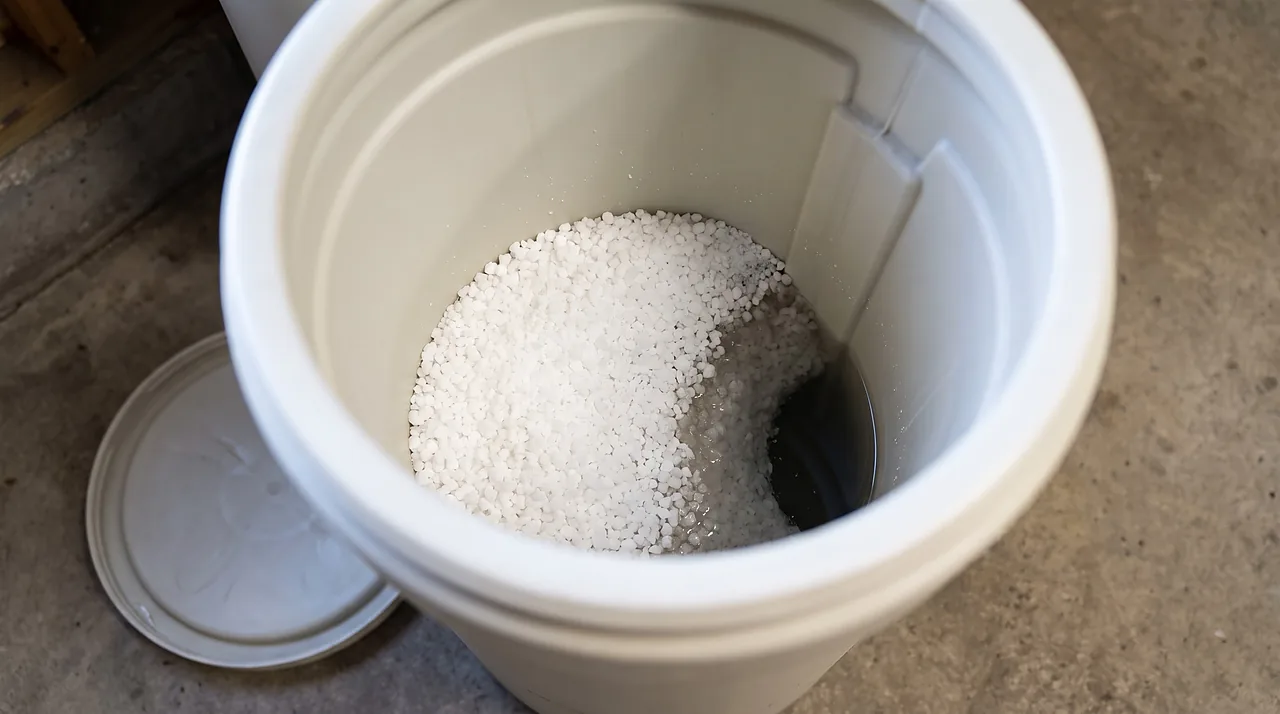
Keep the brine tank, the shorter tank that holds the salt, a quarter to half full, with the salt always higher than the water. Check it once a month. Most households go through about 40 to 80 pounds a month, which is one or two 40-pound bags.
That's the rule, but the lid doesn't come with a ruler. You lift it, see a heap of white pellets and maybe some water, and can't tell whether that's plenty or nearly empty. Your monthly salt use is worth tracking too, because it doubles as a free health check on the whole softener.
What 'a quarter to half full' actually looks like

Most brine tanks keep a few inches of water at the bottom. There, salt dissolves into brine for the next regeneration, the softener's cleaning cycle. That water is normal. What matters is that dry salt sits on top of it.
Picture the tank's height in four equal parts. The top of the salt pile should land between the first and second mark from the bottom. If your tank has fill marks inside or your display shows a low-salt alert, use those to find your quarter and half.
- Too low: once the salt drops to the water line, the water can't make full-strength brine. The resin, the beads inside the tall resin tank that trap hardness, comes out of each cycle only partly recharged, and hard water creeps back.
- Too high: a tank filled to the rim leaves salt sitting in damp basement air for months. That's how a salt bridge starts, a hard crust that hangs over an empty space.
- Water above the salt: stop adding salt. Something is keeping water in the tank, and the guide to a brine tank full of water walks through the causes.
Some manuals and dealers allow filling higher, up to about three-quarters. If yours says so, that's fine to follow, but half is the safer target in a damp room.
For the first fill, or after a tank cleaning, pour in one bag at a time until the salt reaches about halfway. Count the bags. That number is your "half full" for as long as you own this softener.
How often to check and add salt
Once a month is enough for most homes. Lift the lid, look at the level, and add a bag when the salt has dropped close to a quarter full. One bag at a time keeps the pile fresh and the crust away.
You don't need to start a regeneration after adding salt. The softener keeps to its usual schedule, and the new salt dissolves on its own. The exception is a tank that ran completely empty. It needs a few hours for brine to form, then a manual regeneration, as explained in softener ran out of salt.
Which bag you pour in matters too, since cheap, dirty salt leaves sludge behind. The guide to salt types compares them. Pair the monthly salt check with the yearly jobs in the maintenance routine.
How much salt a household actually burns through

You can estimate your own monthly use in three steps. You'll need your water hardness in grains per gallon (gpg), the unit softeners are set in. If your water report lists hardness in mg/L or ppm, divide by 17.1 to get gpg, or see the ppm to gpg guide.
- Grains per day. Multiply the people in the house by 75 gallons a day, then by your hardness in gpg. On well water with clear-water iron (iron that comes out of the tap clear and stains later), first add 3 to 5 gpg for every 1 ppm of iron.
- Grains per month. Multiply by 30.
- Pounds of salt. Divide by how many grains each pound of salt removes, which depends on the salt dose in your settings.
- Efficient dose, about 3 lb of salt per cubic foot of resin
- About 4,000 grains per pound, the standard the Water Quality Association asks for.
- Medium dose, about 6 lb per cubic foot
- About 3,300 grains per pound.
- Heaviest dose, about 15 lb per cubic foot
- Only about 2,000 grains per pound, because much of the extra salt goes down the drain.
A family of four on 10 gpg water works out to 3,000 grains a day and 90,000 a month. That's about 23 pounds of salt at the efficient dose, or 45 pounds at the heaviest one.
| Household and hardness | Grains per month | Salt per month, efficient to heavy dose |
|---|---|---|
| 2 people, 8 gpg | 36,000 | About 9 to 18 lb |
| 4 people, 10 gpg | 90,000 | About 23 to 45 lb |
| 4 people, 15 gpg | 135,000 | About 34 to 68 lb |
| 5 people, 15 gpg | 168,750 | About 42 to 84 lb |
| 6 people, 20 gpg | 270,000 | About 68 to 135 lb |
Expect real use to land higher than the math. Many softeners run a medium or heavy dose, and none uses every grain of capacity before it regenerates. That's why so many homes land in the 40 to 80 pound range even when the math says less. Older timer models, which regenerate on a fixed schedule whether you used the water or not, run higher still.
If your number sits near the heavy end, the salt dose in your softener settings is the place to save.
When your salt use is far off: what it tells you
Compare what you pour in each month with your estimate. A big miss in either direction points to a specific problem.
- The salt level hasn't moved in four to eight weeks, though your estimate says it should have
- The softener isn't drawing brine, or isn't regenerating at all. The usual causes are a salt bridge, a clogged injector, or a water meter that stopped counting. The injector is the small nozzle in the control head, the valve on top of the resin tank, that sucks brine out. The meter is the counter that tells the softener when to regenerate. Test for a bridge first, then work through why the softener isn't using salt.
- Three or four bags a month, far more than your estimate
- The softener is regenerating too often or using a heavy salt dose. A running toilet can spin the water meter around the clock. A softener set to a fixed timer regenerates whether you need it or not. See a softener that regenerates too often.
- The tank ran dry and the water is hard
- The resin is spent, and nothing is broken. Refill and follow the recovery steps for a softener that ran out of salt.
- Water has risen over the salt
- The softener refilled the tank but failed to pull the brine out. Don't add salt until you've found the cause.
Testing for a bridge before you assume the worst

A bridged tank looks half full every time you open it. That's why the water turns hard while you're sure there's plenty of salt. The crust holds the top layer up, and underneath it there's only water and empty space.
Push a broom handle straight down through the salt in two or three spots. In a healthy tank it slides through loose salt to the floor. If it stops on a hard layer partway down, that's a bridge.
Break it up by tapping the crust gently with the handle until it falls into the water. Don't jab at the tank walls, which can crack. The full fix is in the guide to breaking a salt bridge.
Your salt, per month and per year
Read next


Questions people ask
How long does a 40-pound bag of salt last?
About two to four weeks for a typical household using 40 to 80 pounds a month. A couple on moderately hard water with an efficient dose can stretch one bag to two months or more.
Can you put too much salt in a water softener?
In the tank, yes: filling it to the rim invites a salt bridge. In the water, no. Each regeneration uses the dose set in the control head, so a fuller tank never makes the water saltier or softer.
Do I ever need to replace the old salt?
No, you only top it up. What does build up is sludge and grit at the bottom, so clean the brine tank every two to three years, more often if you use rock salt.
Does a bigger brine tank change the quarter-to-half rule?
No. The rule is about height, so salt stays above the water without a heavy, crust-prone pile. A bigger tank just holds more bags at the same level.
Does potassium chloride follow the same fill rule?
Yes, same level and same monthly check. It's used differently in the settings, which the <a href="/potassium-chloride-water-softener/">potassium chloride guide</a> covers.
Sources
- U.S. Geological Survey, Hardness of Water
- Water Quality Association, Getting Smart With Softeners